
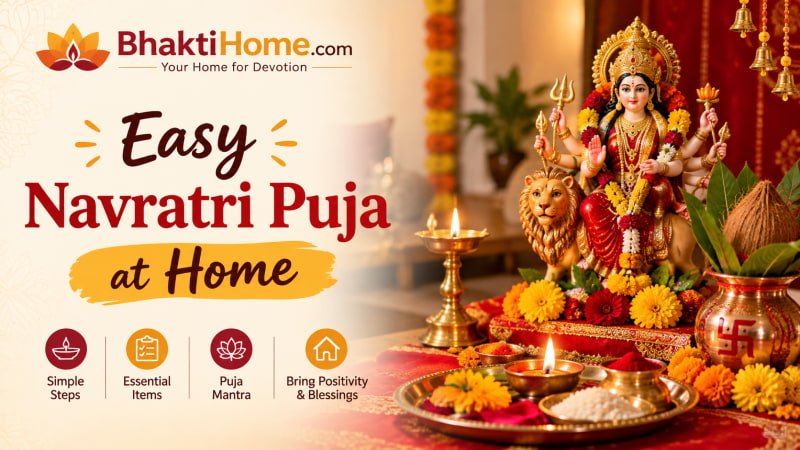
Easy Navratri Puja at Home - Navratri is one of the most sacred Hindu festivals, dedicated to the worship of Goddess Durga and her nine divine forms, known as Navdurga. Celebrated over nine days, this auspicious festival symbolises the victory of good over evil and the triumph of divine feminine energy. Devotees pray to Maa Durga for happiness, prosperity, good health, peace and protection for their families.
Performing Navratri puja at home is a beautiful way to seek the blessings of the Goddess and bring positivity into your home. You do not need elaborate arrangements to perform the rituals. With a clean puja space, a few essential items, sincere devotion and the right prayers, you can worship Maa Durga with faith and devotion.
Easy Navratri Puja at Home: Simple Vidhi and Mantras
In this guide, we explain how to perform Navratri puja at home step by step, including the preparation of the puja space, essential samagri, Kalash Sthapana (Ghatasthapana), daily worship rituals, mantras and aarti. Whether you are observing Navratri for the first time or following your family's traditional customs, these simple instructions will help you celebrate the festival with devotion and understanding.
You can do Navratri puja at home in about 15 minutes a day. Set up a Kalash on Day 1, light a lamp, offer flowers and bhog, chant a few mantras, and finish with aarti. No pandit is needed, only a clean space and sincere devotion.
What You Need
- Idol or picture of Maa Durga, and a red cloth
- Kalash with water, mango leaves, coconut and Moli
- Barley seeds in a pot of soil
- Diya, ghee, incense and camphor
- Red flowers, roli, kumkum and akshat (unbroken rice)
- Fruits or sweets for bhog
Day 1: Set Up (Ghatasthapana)
- Clean the puja corner (North-East if possible) and spread a red cloth.
- Sow barley in the pot and sprinkle a little water.
- Fill the Kalash with water, tie Moli on its neck, and add a coin, supari and akshat.
- Place five mango leaves on the rim, put the coconut wrapped in red cloth on top, and set the Kalash on the barley pot.
- Do this in the morning while Pratipada is in effect. Never at night.
Daily Puja in 6 Steps
- Bathe and sit facing East or North.
- Light the diya near the Goddess.
- Bow to Ganesha with the mantra below.
- Invite the Goddess with flowers, akshat and the mantra below.
- Offer incense, flowers, kumkum and bhog.
- Chant the Navarna mantra, do aarti, and ask forgiveness for any mistakes.
Repeat briefly in the evening with a lamp and aarti. Water the barley once or twice a day.
5 Easy Mantras
1. Ganesh Mantra
वक्रतुण्ड महाकाय सूर्यकोटि समप्रभ।
निर्विघ्नं कुरु मे देव सर्वकार्येषु सर्वदा॥
Vakratuṇḍa mahākāya sūryakoṭi samaprabha | nirvighnaṁ kuru me deva sarvakāryeṣu sarvadā ||
Meaning: O Ganesha, radiant as a million suns, please remove all obstacles from my work.
2. Durga Avahan (Invitation)
ॐ श्री दुर्गादेव्यै नमः, आवाहयामि स्थापयामि॥
Om Śrī Durgādevyai namaḥ, āvāhayāmi sthāpayāmi ||
Meaning: I bow to Goddess Durga. I invite You and establish You here.
3. Navarna Mantra (chant 11 or 108 times)
ॐ ऐं ह्रीं क्लीं चामुण्डायै विच्चे॥
Om aiṁ hrīṁ klīṁ Cāmuṇḍāyai vicce ||
Meaning: A call to the Goddess as wisdom, prosperity and power, asking for her protection and grace.
4. Devi Stuti
या देवी सर्वभूतेषु शक्तिरूपेण संस्थिता।
नमस्तस्यै नमस्तस्यै नमस्तस्यै नमो नमः॥
Yā Devī sarvabhūteṣu śakti-rūpeṇa saṁsthitā | namastasyai namastasyai namastasyai namo namaḥ ||
Meaning: To the Goddess who lives in all beings as power, I bow again and again.
5. Kshama Prarthana (Forgiveness)
आवाहनं न जानामि न जानामि विसर्जनम्।
पूजां चैव न जानामि क्षमस्व परमेश्वरि॥
Āvāhanaṁ na jānāmi na jānāmi visarjanam | pūjāṁ caiva na jānāmi kṣamasva Parameśvari ||
Meaning: I do not know how to invoke, worship or bid You farewell. O Supreme Goddess, please forgive me.
Simple Fasting Tips
- Fasting is optional. Puja and fasting are separate.
- If you fast, eat fruits, milk, sabudana, kuttu or singhara flour, and sendha namak.
- Avoid onion, garlic, grains, meat and alcohol.
- Children, elders, pregnant women and anyone unwell should follow their doctor's advice.
Ashtami or Navami: Kanya Pujan
Invite nine young girls, wash their feet, apply tilak, and serve puri, halwa and black chana. Offer a small gift and take their blessings.
Last Day: Visarjan
Do a final aarti, thank the Goddess, and share the barley sprouts as prasad. Pour the Kalash water at the base of a tree or into a river.
Quick FAQs
Can I do Navratri puja without a pandit?
Yes. A lamp, flowers, bhog, a few mantras and aarti are enough.
What if I miss a day or make a mistake?
Resume the next day and chant the Kshama Prarthana. Devotion matters more than perfect ritual.
What is the best time for daily puja?
Early morning and sunset. Ghatasthapana must be done in the morning muhurat on Pratipada.
Customs vary by region and family. Check a local Panchang for muhurat timings.
Jai Mata Di! 🙏