
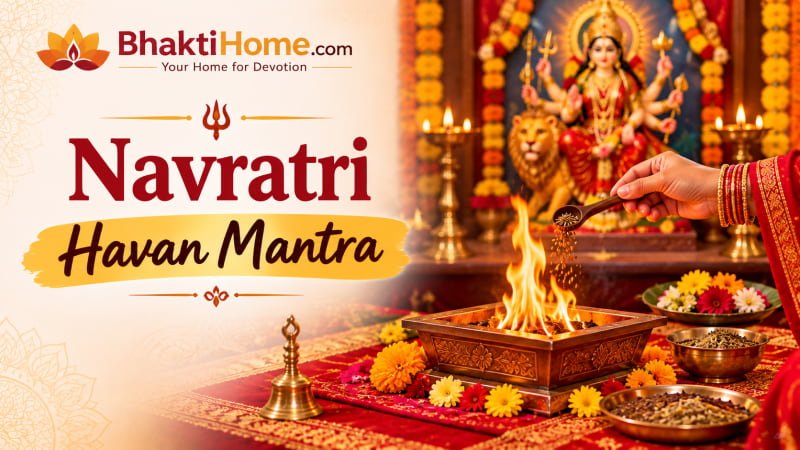
Navratri Havan Mantra - Navratri is the nine-night festival of Goddess Durga and her nine forms, the Navadurga. The festival is traditionally concluded with a havan (homa), a sacred fire ritual on Ashtami or Navami, though some families do it daily. In a havan, offerings (ahuti) are made into the sacred fire along with mantras ending in "Svaha", so that the prayers are carried to the Goddess through Agni, the fire deity.
Navratri Havan Mantra: Meaning, Importance and Complete Mantra List
This guide covers: Navratri havan mantra in Hindi with English transliteration for all nine Durga forms, plus havan vidhi, samagri list, ahuti rules and FAQs.
- What a Navratri havan is and why it is performed
- Havan samagri (materials)
- Step-by-step havan vidhi
- Havan mantras in Hindi with English transliteration
- Mantras for each of the nine Navadurga
- Poornahuti and concluding prayers
- Rules, do's and don'ts, and FAQs
What Is a Navratri Havan and Why Is It Performed?
A havan is a Vedic fire ritual. During Navratri, it is performed to:
- Complete the nine-day worship with a formal offering to the Goddess
- Purify the home and mind, since the smoke of herbs, ghee and wood is traditionally regarded as purifying
- Seek the Goddess's blessings for protection, health, prosperity and peace
- Offer gratitude at the end of fasting and sadhana
- Complete mantra japa, since traditionally the havan offering is made at the end of a chanting practice
Many devotees who read the Durga Saptashati or chant the Navarna mantra conclude with a havan. Doing so is traditional rather than strictly mandatory. A sincere puja and japa without a havan are still valid, as discussed in the earlier article on Navratri puja without Kalash Sthapana.
Navratri Havan Samagri (Materials Required)
| Item | Notes |
|---|---|
| Havan kund (copper, brass or earthen) | A small, safe, ventilated kund works for home use |
| Samidha (wood) | Mango wood is most common; palash and peepal are also used |
| Pure cow ghee | For the ahuti and for lighting |
| Havan samagri mix | A ready mix of herbs, grains, sesame, barley and fragrant substances |
| Camphor (kapoor) | For lighting the fire |
| Black sesame, barley (jau), rice | Added to the samagri |
| Sugar or jaggery, dry fruits | Sweet offerings |
| Lotus seeds (kamal gatta) | Traditionally offered in Devi havans |
| Coconut (whole, with husk removed) | For the Poornahuti |
| Red cloth, roli, kumkum, flowers, akshat | For puja before the havan |
| Kalash or lota of water, small spoon (sruva) | For sprinkling and offerings |
| Betel leaf, fruits, sweets (prasad) | Final offering |
Safety note: Perform the havan in a well-ventilated space, keep water nearby, and avoid it in small, closed rooms or apartments with sensitive smoke detectors. You can use a smaller quantity of samagri.
Navratri Havan Vidhi (Step-by-Step Procedure)
- Purification. Bathe, wear clean clothes, and sit facing east or north.
- Sankalp. Take water in your right palm and state your intention: that you are performing the Navratri havan for the Goddess's blessings.
- Ganesh puja. Begin with Ganesh, the remover of obstacles.
- Kindle the fire. Arrange the samidha in the kund, add camphor and ghee, and light it.
- Agni avahan (invocation of fire).
- Preliminary ahutis (Ganesh, Agni and so on).
- Main ahutis. Offer samagri with each mantra, saying "Svaha" and releasing the offering into the fire.
- Navadurga mantras, one for each goddess (given below).
- Navarna mantra ahutis, traditionally 108 (or 21, 51 or 1,008 as your capacity allows).
- Poornahuti with a ghee-filled coconut.
- Aarti, prayers and forgiveness.
- Prasad distribution and, if you follow it, Kanya Pujan.
- Let the fire subside on its own. Do not extinguish it with water. Once it is cool, the ash is traditionally collected respectfully.
Preliminary Havan Mantras (Before the Main Ahuti)
1. Ganesh Havan Mantra
हिंदी: ॐ गं गणपतये स्वाहा। इदं गणपतये इदं न मम॥
Transliteration: Om Gam Ganapataye Svaha. Idam Ganapataye Idam Na Mama.
2. Agni Havan Mantra
हिंदी: ॐ अग्नये स्वाहा। इदम् अग्नये इदं न मम॥
Transliteration: Om Agnaye Svaha. Idam Agnaye Idam Na Mama.
(Idam na mama means "this is not mine," an offering made without ownership.)
3. Gayatri Mantra Ahuti
हिंदी: ॐ भूर्भुवः स्वः। तत्सवितुर्वरेण्यं भर्गो देवस्य धीमहि। धियो यो नः प्रचोदयात् स्वाहा॥
Transliteration: Om Bhur Bhuvah Svah. Tat Savitur Varenyam Bhargo Devasya Dhimahi. Dhiyo Yo Nah Prachodayat Svaha.
Navratri Havan Mantra for All Nine Goddesses (Navadurga)
For each goddess below, you will find three mantras:
- Havan ahuti mantra: said with each offering, ending in Svaha
- Beej / naam mantra: for japa
- Dhyan shloka: a meditation verse, said before the ahutis for that goddess
For the full ritual, many families offer 11 or 21 ahutis for each goddess; 108 is also common if time allows.
Day 1: Maa Shailputri (शैलपुत्री)
The daughter of the Himalayas. Associated with stability, strength and the root foundation.
Havan Ahuti Mantra
हिंदी: ॐ देवी शैलपुत्र्यै स्वाहा॥
Transliteration: Om Devi Shailaputryai Svaha.
Beej Mantra
हिंदी: ॐ ऐं ह्रीं क्लीं शैलपुत्र्यै नमः॥
Transliteration: Om Aim Hreem Kleem Shailaputryai Namah.
Dhyan Shloka
हिंदी: वन्दे वाञ्छितलाभाय चन्द्रार्धकृतशेखराम्। वृषारूढां शूलधरां शैलपुत्रीं यशस्विनीम्॥
Transliteration: Vande Vanchhita-Labhaya Chandrardha-Kritashekharam. Vrisharudham Shuladharam Shailaputrim Yashasvinim.
Stuti
हिंदी: या देवी सर्वभूतेषु शैलपुत्री रूपेण संस्थिता। नमस्तस्यै नमस्तस्यै नमस्तस्यै नमो नमः॥
Transliteration: Ya Devi Sarvabhuteshu Shailaputri Rupena Samsthita. Namastasyai Namastasyai Namastasyai Namo Namah.
Day 2: Maa Brahmacharini (ब्रह्मचारिणी)
The Goddess of penance, discipline and knowledge.
Havan Ahuti Mantra
हिंदी: ॐ देवी ब्रह्मचारिण्यै स्वाहा॥
Transliteration: Om Devi Brahmacharinyai Svaha.
Beej Mantra
हिंदी: ॐ ऐं ह्रीं क्लीं ब्रह्मचारिण्यै नमः॥
Transliteration: Om Aim Hreem Kleem Brahmacharinyai Namah.
Dhyan Shloka
हिंदी: दधाना करपद्माभ्यामक्षमालाकमण्डलू। देवी प्रसीदतु मयि ब्रह्मचारिण्यनुत्तमा॥
Transliteration: Dadhana Karapadmabhyam Akshamala-Kamandalu. Devi Prasidatu Mayi Brahmacharinyanuttama.
Stuti
हिंदी: या देवी सर्वभूतेषु ब्रह्मचारिणी रूपेण संस्थिता। नमस्तस्यै नमस्तस्यै नमस्तस्यै नमो नमः॥
Transliteration: Ya Devi Sarvabhuteshu Brahmacharini Rupena Samsthita. Namastasyai Namastasyai Namastasyai Namo Namah.
Day 3: Maa Chandraghanta (चन्द्रघण्टा)
The Goddess with a crescent moon shaped like a bell on her forehead. Associated with courage and peace.
Havan Ahuti Mantra
हिंदी: ॐ देवी चन्द्रघण्टायै स्वाहा॥
Transliteration: Om Devi Chandraghantayai Svaha.
Beej Mantra
हिंदी: ॐ ऐं ह्रीं क्लीं चन्द्रघण्टायै नमः॥
Transliteration: Om Aim Hreem Kleem Chandraghantayai Namah.
Dhyan Shloka
हिंदी: पिण्डजप्रवरारूढा चण्डकोपास्त्रकैर्युता। प्रसादं तनुते मह्यं चन्द्रघण्टेति विश्रुता॥
Transliteration: Pindaja-Pravararudha Chandakopastrakairyuta. Prasadam Tanute Mahyam Chandraghanteti Vishruta.
Stuti
हिंदी: या देवी सर्वभूतेषु चन्द्रघण्टा रूपेण संस्थिता। नमस्तस्यै नमस्तस्यै नमस्तस्यै नमो नमः॥
Transliteration: Ya Devi Sarvabhuteshu Chandraghanta Rupena Samsthita. Namastasyai Namastasyai Namastasyai Namo Namah.
Day 4: Maa Kushmanda (कूष्माण्डा)
The creator of the universe with her gentle smile. Associated with health and vitality.
Havan Ahuti Mantra
हिंदी: ॐ देवी कूष्माण्डायै स्वाहा॥
Transliteration: Om Devi Kushmandayai Svaha.
Beej Mantra
हिंदी: ॐ ऐं ह्रीं क्लीं कूष्माण्डायै नमः॥
Transliteration: Om Aim Hreem Kleem Kushmandayai Namah.
Dhyan Shloka
हिंदी: सुरासम्पूर्णकलशं रुधिराप्लुतमेव च। दधाना हस्तपद्माभ्यां कूष्माण्डा शुभदास्तु मे॥
Transliteration: Surasampurna-Kalasham Rudhiraplutameva Cha. Dadhana Hastapadmabhyam Kushmanda Shubhadastu Me.
Stuti
हिंदी: या देवी सर्वभूतेषु कूष्माण्डा रूपेण संस्थिता। नमस्तस्यै नमस्तस्यै नमस्तस्यै नमो नमः॥
Transliteration: Ya Devi Sarvabhuteshu Kushmanda Rupena Samsthita. Namastasyai Namastasyai Namastasyai Namo Namah.
Day 5: Maa Skandamata (स्कन्दमाता)
The mother of Kartikeya (Skanda). Associated with motherly love and protection.
Havan Ahuti Mantra
हिंदी: ॐ देवी स्कन्दमातायै स्वाहा॥
Transliteration: Om Devi Skandamatayai Svaha.
Beej Mantra
हिंदी: ॐ ऐं ह्रीं क्लीं स्कन्दमातायै नमः॥
Transliteration: Om Aim Hreem Kleem Skandamatayai Namah.
Dhyan Shloka
हिंदी: सिंहासनगता नित्यं पद्माञ्चितकरद्वया। शुभदास्तु सदा देवी स्कन्दमाता यशस्विनी॥
Transliteration: Simhasanagata Nityam Padmanchita-Karadvaya. Shubhadastu Sada Devi Skandamata Yashasvini.
Stuti
हिंदी: या देवी सर्वभूतेषु स्कन्दमाता रूपेण संस्थिता। नमस्तस्यै नमस्तस्यै नमस्तस्यै नमो नमः॥
Transliteration: Ya Devi Sarvabhuteshu Skandamata Rupena Samsthita. Namastasyai Namastasyai Namastasyai Namo Namah.
Day 6: Maa Katyayani (कात्यायनी)
The warrior form, born of sage Katyayana. Associated with courage and the destruction of negativity.
Havan Ahuti Mantra
हिंदी: ॐ देवी कात्यायन्यै स्वाहा॥
Transliteration: Om Devi Katyayanyai Svaha.
Beej Mantra
हिंदी: ॐ ऐं ह्रीं क्लीं कात्यायन्यै नमः॥
Transliteration: Om Aim Hreem Kleem Katyayanyai Namah.
Dhyan Shloka
हिंदी: चन्द्रहासोज्ज्वलकरा शार्दूलवरवाहना। कात्यायनी शुभं दद्यादेवी दानवघातिनी॥
Transliteration: Chandrahasojjvalakara Shardula-Varavahana. Katyayani Shubham Dadyad Devi Danavaghatini.
Stuti
हिंदी: या देवी सर्वभूतेषु कात्यायनी रूपेण संस्थिता। नमस्तस्यै नमस्तस्यै नमस्तस्यै नमो नमः॥
Transliteration: Ya Devi Sarvabhuteshu Katyayani Rupena Samsthita. Namastasyai Namastasyai Namastasyai Namo Namah.
Day 7: Maa Kalaratri (कालरात्रि)
The fierce form that removes fear and darkness. She is also the protector of her devotees.
Havan Ahuti Mantra
हिंदी: ॐ देवी कालरात्र्यै स्वाहा॥
Transliteration: Om Devi Kalaratryai Svaha.
Beej Mantra
हिंदी: ॐ ऐं ह्रीं क्लीं कालरात्र्यै नमः॥
Transliteration: Om Aim Hreem Kleem Kalaratryai Namah.
Dhyan Shloka
हिंदी: करालवदनां घोरां मुक्तकेशीं चतुर्भुजाम्। कालरात्रिं करालिकां दिव्यां विद्युन्मालाविभूषिताम्॥
Transliteration: Karalavadanam Ghoram Muktakeshim Chaturbhujam. Kalaratrim Karalikam Divyam Vidyunmala-Vibhushitam.
Stuti
हिंदी: या देवी सर्वभूतेषु कालरात्रि रूपेण संस्थिता। नमस्तस्यै नमस्तस्यै नमस्तस्यै नमो नमः॥
Transliteration: Ya Devi Sarvabhuteshu Kalaratri Rupena Samsthita. Namastasyai Namastasyai Namastasyai Namo Namah.
Day 8: Maa Mahagauri (महागौरी)
The radiant, serene form associated with purity and forgiveness. Durgashtami havan and Kanya Pujan are commonly done on this day.
Havan Ahuti Mantra
हिंदी: ॐ देवी महागौर्यै स्वाहा॥
Transliteration: Om Devi Mahagauryai Svaha.
Beej Mantra
हिंदी: ॐ ऐं ह्रीं क्लीं महागौर्यै नमः॥
Transliteration: Om Aim Hreem Kleem Mahagauryai Namah.
Dhyan Shloka
हिंदी: श्वेते वृषे समारूढा श्वेताम्बरधरा शुचिः। महागौरी शुभं दद्यान्महादेवप्रमोददा॥
Transliteration: Shvete Vrishe Samarudha Shvetambaradhara Shuchih. Mahagauri Shubham Dadyan Mahadeva-Pramodada.
Stuti
हिंदी: या देवी सर्वभूतेषु महागौरी रूपेण संस्थिता। नमस्तस्यै नमस्तस्यै नमस्तस्यै नमो नमः॥
Transliteration: Ya Devi Sarvabhuteshu Mahagauri Rupena Samsthita. Namastasyai Namastasyai Namastasyai Namo Namah.
Day 9: Maa Siddhidatri (सिद्धिदात्री)
The giver of siddhis (spiritual accomplishments). Navami havan is traditionally performed on this day.
Havan Ahuti Mantra
हिंदी: ॐ देवी सिद्धिदात्र्यै स्वाहा॥
Transliteration: Om Devi Siddhidatryai Svaha.
Beej Mantra
हिंदी: ॐ ऐं ह्रीं क्लीं सिद्धिदात्र्यै नमः॥
Transliteration: Om Aim Hreem Kleem Siddhidatryai Namah.
Dhyan Shloka
हिंदी: सिद्धगन्धर्वयक्षाद्यैरसुरैरमरैरपि। सेव्यमाना सदा भूयात् सिद्धिदा सिद्धिदायिनी॥
Transliteration: Siddhagandharva-Yakshadyair-Asurair-Amarair-Api. Sevyamana Sada Bhuyat Siddhida Siddhidayini.
Stuti
हिंदी: या देवी सर्वभूतेषु सिद्धिदात्री रूपेण संस्थिता। नमस्तस्यै नमस्तस्यै नमस्तस्यै नमो नमः॥
Transliteration: Ya Devi Sarvabhuteshu Siddhidatri Rupena Samsthita. Namastasyai Namastasyai Namastasyai Namo Namah.
Main Durga Havan Mantras (Common to All Nine Days)
1. Navarna Mantra Havan Ahuti (Most Important)
The Navarna ("nine-syllable") mantra is the heart of Devi worship. It is chanted for japa during Navratri and is commonly used for the main havan ahuti.
हिंदी: ॐ ऐं ह्रीं क्लीं चामुण्डायै विच्चे स्वाहा॥
Transliteration: Om Aim Hreem Kleem Chamundayai Vichche Svaha.
Traditional count: 108 ahutis (or 21, 51 or 1,008).
2. Durga Beej Mantra Ahuti
हिंदी: ॐ दुं दुर्गायै नमः स्वाहा॥
Transliteration: Om Dum Durgayai Namah Svaha.
3. Durga Gayatri Mantra Ahuti
हिंदी: ॐ गिरिजायै च विद्महे शिवप्रियायै च धीमहि। तन्नो दुर्गा प्रचोदयात् स्वाहा॥
Transliteration: Om Girijayai Cha Vidmahe Shivapriyayai Cha Dhimahi. Tanno Durga Prachodayat Svaha.
4. Jayanti Mangala Kali Mantra (Siddha Kunjika / Kavach Verse)
हिंदी: ॐ जयन्ती मङ्गला काली भद्रकाली कपालिनी। दुर्गा क्षमा शिवा धात्री स्वाहा स्वधा नमोऽस्तु ते॥
Transliteration: Om Jayanti Mangala Kali Bhadrakali Kapalini. Durga Kshama Shiva Dhatri Svaha Svadha Namo'stu Te.
5. Sarva-Mangala Mantra Ahuti
हिंदी: सर्वमङ्गलमाङ्गल्ये शिवे सर्वार्थसाधिके। शरण्ये त्र्यम्बके गौरि नारायणि नमोऽस्तु ते स्वाहा॥
Transliteration: Sarva-Mangala-Mangalye Shive Sarvartha-Sadhike. Sharanye Tryambake Gauri Narayani Namo'stu Te Svaha.
6. Maha Durga Mantra for Protection
हिंदी: ॐ ह्रीं दुं दुर्गायै नमः स्वाहा॥
Transliteration: Om Hreem Dum Durgayai Namah Svaha.
Poornahuti Mantra (Final Offering)
The Poornahuti marks the completion of the havan. A coconut filled with ghee, samagri and dry fruits is wrapped in a red cloth or tied with a thread and offered into the fire.
Poornahuti Mantra
हिंदी: ॐ पूर्णमदः पूर्णमिदं पूर्णात्पूर्णमुदच्यते। पूर्णस्य पूर्णमादाय पूर्णमेवावशिष्यते॥
Transliteration: Om Purnamadah Purnamidam Purnat Purnamudachyate. Purnasya Purnamadaya Purnamevavashishyate.
Shanti Path (Closing Peace Chant)
हिंदी: ॐ सर्वे भवन्तु सुखिनः सर्वे सन्तु निरामयाः। सर्वे भद्राणि पश्यन्तु मा कश्चिद्दुःखभाग्भवेत्॥ ॐ शान्तिः शान्तिः शान्तिः॥
Transliteration: Om Sarve Bhavantu Sukhinah Sarve Santu Niramayah. Sarve Bhadrani Pashyantu Ma Kashchid Duhkha-Bhag-Bhavet. Om Shantih Shantih Shantih.
Forgiveness Prayer (Kshama Prarthana)
It is customary to ask the Goddess's forgiveness for any mistakes made during the ritual.
हिंदी: मन्त्रहीनं क्रियाहीनं भक्तिहीनं सुरेश्वरि। यत्पूजितं मया देवि परिपूर्णं तदस्तु मे॥
Transliteration: Mantraheenam Kriyaheenam Bhaktiheenam Sureshvari. Yat Pujitam Maya Devi Paripurnam Tadastu Me.
This verse expresses that whatever was lacking in mantra, action or devotion, the Goddess may accept the worship as complete.
Navratri Havan Rules, Do's and Don'ts
Do:
- Maintain physical and mental cleanliness
- Use pure ghee and fresh samagri
- Pronounce mantras as correctly as you can, and say "Svaha" while releasing the offering
- Make each offering with the right hand (using the ring finger and thumb is a common tradition)
- Keep the Goddess's picture or idol in front of the havan kund
- Seek guidance from a pandit or elder for your family's specific tradition
Don't:
- Don't use plastic, synthetic materials, or damp wood
- Don't throw non-ritual items (wrappers, paper) into the fire
- Don't extinguish the fire with water
- Don't leave the fire unattended
- Don't worry excessively about small pronunciation errors. Tradition places devotion above perfect recitation, and the Kshama Prarthana above exists for exactly this reason.
Best Time (Muhurat) for Navratri Havan
Havan is commonly performed on Ashtami or Navami after the main puja, preferably in the morning. Some devotees perform a short daily havan, and the timing of Ashtami/Navami changes every year. Check a trusted Panchang or consult your family pandit for the exact tithi and muhurat for the current year.
Frequently Asked Questions (FAQs)
1. Can I perform Navratri havan at home?
Yes. A small havan in a copper or earthen kund is common in homes. Keep the space ventilated and use a modest amount of samagri.
2. Is havan mandatory in Navratri?
No. It is a traditional way to conclude the nine days but not a strict requirement. Puja, japa, fasting and devotion are valid without it.
3. Which havan mantra is best for Navratri?
The Navarna mantra "Om Aim Hreem Kleem Chamundayai Vichche Svaha" is the most widely used. Many families also add the Durga Gayatri and the individual Navadurga mantras.
4. How many ahutis should I offer?
108 is the traditional number for the main mantra. If time is short, 21 or 51 is acceptable.
5. Can women perform havan?
Yes. Women and men both perform havan in Devi worship, and in many homes it is led by women.
6. Can I do havan without a pandit?
Yes, a simple havan can be done at home with devotion and basic knowledge. For elaborate Vedic procedures or family customs, a pandit's guidance is helpful.
7. What if I make mistakes in the mantra?
Recite the Kshama Prarthana at the end and continue with sincerity. Learning pronunciation from a teacher or a good audio recording will help over time.
8. Can I perform havan if I haven't done Kalash Sthapana?
Yes. Havan is independent of Kalash Sthapana.
9. What should I do with the havan ash?
Once it is completely cool, it is traditionally treated with respect, for example placed at the base of a tree or in flowing water. Do not discard it carelessly.
Conclusion
The Navratri havan is a powerful and graceful way to complete the nine nights of Devi worship. With the Navarna mantra, the Durga Gayatri, and the individual mantras for Shailputri to Siddhidatri, you can offer your devotion in a structured way. If your time or resources are limited, even a short havan with the Navarna mantra and a Poornahuti, offered with sincere devotion, is considered meaningful.
Jai Mata Di! 🙏
Disclaimer: Mantras and rituals vary by region, lineage (sampradaya) and family tradition. Pronunciations and verse variants differ slightly between sources. For a formal anushthana or one tied to a specific wish, please consult a qualified pandit or your family guru.