
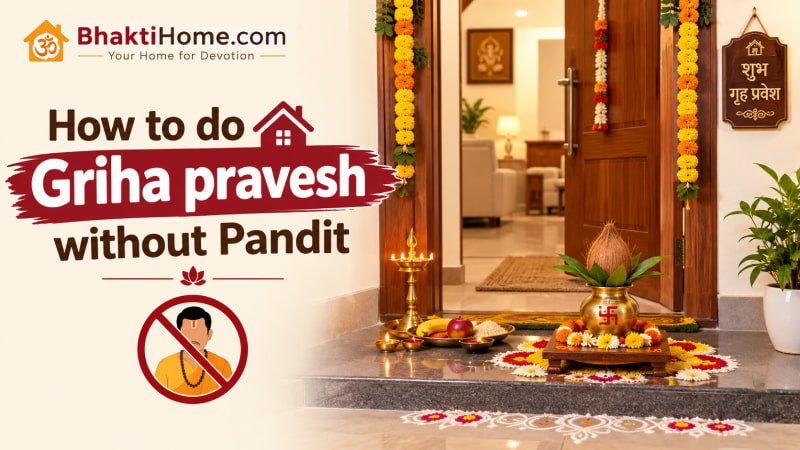
How to do Griha pravesh without Pandit - Entering a new home is one of the most emotional moments in life. In Hindu tradition, the ceremony that marks this moment is Griha Pravesh (also spelt Grih Pravesh or Gruhapravesh), the formal entry into a new house with prayers to invite peace, prosperity and positive energy.
How to Do Griha Pravesh Without Pandit
Find Complete Guide with Mantras, Rituals and Samagri List
Traditionally a pandit conducts the ceremony. But many families today live in cities where a priest is hard to find at short notice, are away from their native place, or simply prefer a quiet, personal ceremony. The good news: you can perform Griha Pravesh yourself. The scriptures place devotion (shraddha) and correct intent (bhava) above elaborate ritual, and a head of the family has the right to perform household worship.
This guide walks you through everything: when to do it, what to buy, the exact step-by-step vidhi, the mantras (in Devanagari with transliteration), and answers to common questions.
A note on traditions: Griha Pravesh customs differ across regions, communities and family lineages (kuladharma). Use this guide as a reliable, simple framework and adapt small details to your family's custom. For anything specific to your gotra or community, ask an elder in your family.
What Is Griha Pravesh and Why Is It Done?
Griha means house and pravesh means entry. The ceremony:
- Purifies the space and removes negative or stagnant energy
- Seeks the blessings of Lord Ganesha, the remover of obstacles
- Invokes Goddess Lakshmi for prosperity and Lord Vishnu for protection
- Honours Vastu Purusha, the presiding deity of the land and structure, and the Navagrahas (nine planets)
- Marks the home as a sacred space where the family will live, grow and worship
Types of Griha Pravesh
- Apoorva Griha Pravesh: entering a brand-new house for the first time. This is the most elaborate form.
- Sapoorva Griha Pravesh: entering a previously occupied or resale house. Extra emphasis on cleansing and purification.
- Dwandwa Griha Pravesh: re-entering your home after a long absence, major renovation, or after a calamity such as fire or flood.
Can You Really Do Griha Pravesh Without a Pandit?
Yes. Hindu household rituals are fundamentally grihastha dharma, duties of the householder. A pandit brings expertise in Sanskrit recitation and complex Vedic procedure, but the essential ingredients are:
- An auspicious time (muhurat)
- A clean, prepared home
- Sincere worship of Ganesha, Lakshmi, Vishnu, Vastu Purusha and the Navagrahas
- A fire offering (havan), or at minimum a lamp and sacred offerings
- Following the key customs: kalash, threshold entry, milk boiling
If you are unsure about pronunciation, you can chant simple beej and name mantras (such as "Om Gam Ganapataye Namah"), play a recording of the mantras, or read them slowly from this guide. Sincerity matters more than perfection.
Step 1: Choose an Auspicious Muhurat
Even without a pandit, fix the date using a Panchang (Hindu almanac). Use a trusted Panchang for your city, since timings change with location.
General guidelines (confirm with a Panchang):
- Favourable months: Magha, Phalguna, Vaishakha, Jyeshtha, and often Margashirsha and Shravana are considered good for Griha Pravesh.
- Avoid: Chaturmas (roughly from Devshayani Ekadashi to Prabodhini Ekadashi), Pitru Paksha, Adhik Maas (extra month), Kharmas (when the Sun is in Sagittarius or Pisces), and eclipse days.
- Favourable days: Monday, Wednesday, Thursday and Friday are widely preferred. Many traditions avoid Tuesday and Saturday.
- Favourable tithis: Dwitiya, Tritiya, Panchami, Saptami, Dashami, Ekadashi and Trayodashi in Shukla Paksha (waxing moon) are generally preferred. Avoid Rikta tithis (Chaturthi, Navami, Chaturdashi) and Amavasya.
- Favourable nakshatras: Rohini, Mrigashira, Uttara Phalguni, Uttara Ashadha, Uttara Bhadrapada, Anuradha, Revati, Dhanishta, Shatabhisha and Pushya.
- Time of day: Morning during the Brahma Muhurat or an auspicious choghadiya is ideal. Avoid Rahu Kaal, Yamaganda and Gulika Kaal.
Practical tip: Search for "Griha Pravesh muhurat" with your city and year on a reputable Panchang website, or ask a family elder. This one consultation is the only "outside help" you really need.
Step 2: Prepare the House (1 to 2 Days Before)
- Deep clean every room. Remove construction debris, cobwebs and unused items.
- Sprinkle Gangajal (or clean water mixed with a few drops of Gangajal and a pinch of turmeric) in every room, starting from the northeast and finishing at the entrance.
- Fix the entrance: hang a toran of fresh mango and ashoka leaves (or marigold flowers) on the main door.
- Draw rangoli at the entrance. Add small footprints of Goddess Lakshmi (using rice flour or kumkum) pointing inwards.
- Place a Swastik on both sides of the main door with kumkum or turmeric paste.
- Keep the kitchen ready with gas or stove connected, a new vessel for milk and a bag of rice.
- Set up a puja space, ideally in the northeast corner (Ishanya) of the house, or any clean space facing east or north.
- Make sure electricity and water work, and place a few basic items (a bed or mat, vessels) so the house isn't completely empty.
- Keep lights on in the house the night before as an auspicious gesture.
Griha Pravesh Samagri List: Complete Puja Items Checklist
Buy everything a day or two in advance. Here is a full checklist.
Essential puja items
- Idols or framed pictures of Ganesha, Lakshmi, Vishnu (or Satyanarayan), and your kuladevta/ishta devata
- A small Vastu Purusha image or a drawn Vastu mandala (optional)
- Kalash (copper or brass pot) filled with water
- Coconut (with fibre, one for kalash and one for offering)
- Mango leaves (5 or 7 leaves) and betel (paan) leaves
- Gangajal and clean water
- Roli/kumkum, haldi (turmeric), chandan (sandalwood paste)
- Akshat (unbroken raw rice, mixed with a little turmeric or kumkum)
- Moli/kalawa (red-yellow sacred thread)
- Janeu (sacred thread, if your tradition offers it to Ganesha) and cloth/vastra for deities (red or yellow)
- Flowers (marigold, rose, lotus), flower garlands, durva grass (for Ganesha) and tulsi leaves (for Vishnu)
- Incense sticks (agarbatti), dhoop, camphor (kapoor)
- Ghee diya and oil diya, cotton wicks, matchbox
- Bell (ghanti), conch (shankh) if available
- Panchamrit ingredients: milk, curd, honey, ghee, sugar
- Fruits (5 types, including banana), dry fruits, sweets (mithai/laddoo/kheer), batasha
- Betel nut (supari), cloves, cardamom, dakshina coins
- Navagraha samagri: 9 types of grains (wheat, rice, toor dal, moong, chana, white sesame, urad, black sesame, barley) or simply 9 small heaps of rice
- Red cloth to place the kalash on, and a wooden chowki/patta
- Aasan (mat) for sitting
For the havan (optional but recommended)
- Havan kund (copper, brass or a clean metal bowl with sand) or a small clay vessel
- Mango wood (aam ki lakdi) sticks, or cow-dung cakes (upla)
- Havan samagri (ready-made packet available in puja stores)
- Pure cow ghee, camphor, black sesame, barley, rice, sugar
- A spoon (sruva) for ghee offerings, and a plate
For the threshold and entry
- Kalash with coconut and mango leaves (carried in by the lady of the house)
- Aarti thali with diya, kumkum, rice and flowers
- Lakshmi footprints and rangoli colours
- Bag of rice or a vessel of rice (to be gently tipped over at the threshold in some traditions)
- New vessel and milk for boiling
- Fresh sweets to boil in milk (sugar or rice for kheer)
Other Items
- Lord Ganesha idol for Dehali (threshold) puja
- Salt, turmeric, a broom and a new matka (some families keep these as symbols of prosperity, to be carried in on day one)
- Tulsi plant (to be placed in the northeast or at the entrance)
- Prasad bags for guests
Griha Pravesh Puja Vidhi at Home: Step-by-Step
This is the complete sequence a householder can perform. Allow about 1.5 to 2 hours with havan, or 45 minutes for a simplified version.
Step 1: Early morning bath and dress
Both husband and wife (or the head of the family) bathe early, wear fresh, clean traditional clothes and apply a tilak. Avoid black. The couple should sit together for the puja if possible.
Step 2: Enter the house and begin at the threshold (Dwar puja)
Before you enter, stand outside the main door facing it. Offer a short prayer to the doorway and to Lord Ganesha. Apply kumkum and turmeric to the threshold, place a small diya on either side, and offer flowers.
Mantra for the door and threshold:
ॐ द्वारदेवताभ्यो नमः। Om Dvaar-devataabhyo Namah.
ॐ गं गणपतये नमः। Om Gam Ganapataye Namah.
Step 3: Entering the house (Pravesh)
Traditional custom:
- The lady of the house enters first, carrying the kalash filled with water (or a kalash topped with a coconut and mango leaves).
- Enter with the right foot first. Do not step on the threshold itself; step over it.
- Chant the Ganesha mantra or recite "Om Namo Narayanaya" as you step in.
- Others follow in order: the male head of the family, then children and elders.
- Some families have the cow and calf (or a picture of a cow) lead in, symbolising prosperity. This is optional and often replaced by an image.
Mantra while entering:
वक्रतुण्ड महाकाय सूर्यकोटि समप्रभ। निर्विघ्नं कुरु मे देव सर्वकार्येषु सर्वदा॥
Vakratunda Mahakaya Suryakoti Samaprabha, Nirvighnam Kuru Me Deva Sarva-karyeshu Sarvada.
(Meaning: O Lord with the curved trunk and mighty body, radiant like a million suns, please remove all obstacles from my endeavours, always.)
Step 4: Place the puja items and sit
Set up the puja area in the northeast. Spread a red or yellow cloth on the chowki, place idols or pictures of Ganesha, Lakshmi and Vishnu, and arrange the samagri. Light the ghee diya and incense. Sit on your aasan facing east or north.
Step 5: Self-purification (Pavitrikaran and Achaman)
Sprinkle a little Gangajal on yourself and the puja items while chanting:
ॐ अपवित्रः पवित्रो वा सर्वावस्थां गतोऽपि वा। यः स्मरेत् पुण्डरीकाक्षं स बाह्याभ्यन्तरः शुचिः॥
Om Apavitrah Pavitro Va Sarvavasthaam Gato'pi Va, Yah Smaret Pundarikaaksham Sa Baahyaabhyantarah Shuchih.
Achaman (sipping water thrice): Take a small spoon of water in your right palm and sip it each time while chanting:
- ॐ केशवाय नमः। Om Keshavaya Namah.
- ॐ नारायणाय नमः। Om Narayanaya Namah.
- ॐ माधवाय नमः। Om Madhavaya Namah.
Then wash your hand while saying: ॐ गोविन्दाय नमः। Om Govindaya Namah.
Step 6: Light the lamp (Deep Prajwalan)
शुभं करोति कल्याणम् आरोग्यं धनसम्पदा। शत्रुबुद्धिविनाशाय दीपज्योतिर्नमोऽस्तुते॥
Shubham Karoti Kalyanam Aarogyam Dhana-sampada, Shatru-buddhi-vinashaya Deepa-jyotir-namo'stute.
Step 7: Sankalp (the vow of intent)
The sankalp declares who you are, what you are doing and why. Take a little water, rice and a flower in your right hand. In Sanskrit it is long, but you may say it in your own language. A simple version:
"I, [your full name], [son/daughter] of [father's name], of [gotra, if known], resident of [city], on this auspicious day [date, tithi, nakshatra, if known], am performing the Griha Pravesh puja in my new home at [address or locality]. I offer this worship to Lord Ganesha, Goddess Lakshmi, Lord Vishnu, Vastu Purusha and the Navagrahas for the peace, health, happiness and prosperity of my family. May all obstacles be removed and may the divine bless this home."
Then release the water onto a plate or the ground.
Step 8: Ganesh Puja (invoking the remover of obstacles)
Always begin with Ganesha. Place Ganesha on the chowki, offer water, then:
- Offer kumkum, chandan and akshat
- Offer durva grass (21 blades if possible), flowers and modak or laddoo
- Light incense and show the diya
Mantras:
ॐ गं गणपतये नमः। Om Gam Ganapataye Namah. (chant 11 or 21 times)
गजाननं भूतगणादिसेवितं कपित्थजम्बूफलचारुभक्षणम्। उमासुतं शोकविनाशकारणं नमामि विघ्नेश्वरपादपङ्कजम्॥ Gajananam Bhuta-ganadi-sevitam Kapittha-jambu-phala-charu-bhakshanam, Uma-sutam Shoka-vinasha-karanam Namami Vighneshvara-pada-pankajam.
Step 9: Kalash Sthapana (installing the sacred pot)
The kalash represents the cosmos and all deities.
- Draw a small swastik on the chowki and spread a handful of rice.
- Fill the kalash with clean water, add a few drops of Gangajal, a coin, a betel nut, a little rice and a flower.
- Place 5 or 7 mango leaves around the mouth.
- Wrap the coconut in red cloth (or tie it with moli), place it on top, and apply kumkum.
- Tie moli around the neck of the kalash.
- Set it down on the rice while chanting.
Invocation of holy rivers:
गङ्गे च यमुने चैव गोदावरि सरस्वति। नर्मदे सिन्धु कावेरि जलेऽस्मिन् सन्निधिं कुरु॥
Gange Cha Yamune Chaiva Godavari Sarasvati, Narmade Sindhu Kaveri Jale'smin Sannidhim Kuru.
Kalash mantra:
कलशस्य मुखे विष्णुः कण्ठे रुद्रः समाश्रितः। मूले तत्र स्थितो ब्रह्मा मध्ये मातृगणाः स्मृताः॥
Kalashasya Mukhe Vishnuh Kanthe Rudrah Samashritah, Moole Tatra Sthito Brahma Madhye Matri-ganah Smritah.
Then offer a flower and rice at the kalash and say ॐ वरुणाय नमः। Om Varunaya Namah.
Step 10: Navagraha Puja (worship of the nine planets)
Place nine small heaps of rice (or the nine grains) on a clean cloth, and offer flowers and akshat to each as you chant its mantra. A simple, widely accepted method is to chant each name mantra once:
- ॐ सूर्याय नमः। Om Suryaya Namah.
- ॐ चन्द्राय नमः। Om Chandraya Namah.
- ॐ भौमाय नमः। Om Bhaumaya Namah. (Mangal)
- ॐ बुधाय नमः। Om Budhaya Namah.
- ॐ गुरवे नमः। Om Gurave Namah. (Brihaspati)
- ॐ शुक्राय नमः। Om Shukraya Namah.
- ॐ शनैश्चराय नमः। Om Shanaishcharaya Namah.
- ॐ राहवे नमः। Om Rahave Namah.
- ॐ केतवे नमः। Om Ketave Namah.
Step 11: Vastu Purusha Puja (worship of the house deity)
Vastu Purusha is the spiritual spirit of the plot and the building. Offer him kumkum, rice, flowers, sweets and a lamp.
ॐ वास्तोष्पते प्रति जानीह्यस्मान् स्वावेशो अनमीवो भवा नः। यत्त्वेमहे प्रति तन्नो जुषस्व शं नो भव द्विपदे शं चतुष्पदे॥ Om Vastoshpate Prati Jaaneehyasmaan Svaavesho Anameevo Bhavaa Nah, Yat Tvemahe Prati Tanno Jushasva Sham No Bhava Dvipade Sham Chatushpade.
(This is the famous Rigvedic prayer to Vastoshpati, asking him to be a friendly, healing guardian of the home for humans and animals alike.)
Simple alternative: ॐ वास्तुपुरुषाय नमः। Om Vastupurushaya Namah. (chant 11 times)
Step 12: Lakshmi and Vishnu Puja
Place the Lakshmi and Vishnu pictures or idols and offer water, kumkum, flowers, sweets and a lamp. Offer tulsi leaves to Vishnu (never to Ganesha).
Lakshmi mantra:
ॐ श्रीं ह्रीं श्रीं कमले कमलालये प्रसीद प्रसीद। ॐ श्रीं ह्रीं श्रीं महालक्ष्म्यै नमः॥
Om Shreem Hreem Shreem Kamale Kamalalaye Praseed Praseed, Om Shreem Hreem Shreem Mahalakshmyai Namah.
Shorter:
ॐ श्रीं महालक्ष्म्यै नमः।
Om Shreem Mahalakshmyai Namah. (chant 11 or 108 times)
Vishnu mantra:
ॐ नमो भगवते वासुदेवाय।
Om Namo Bhagavate Vasudevaya. (11 or 108 times)
You may also recite the Vishnu Sahasranama, Lakshmi Ashtottara, Sundarkand or the Hanuman Chalisa after the main puja. Many families read or listen to the Hanuman Chalisa for protection of the new home.
Step 13: Havan (sacred fire ritual)
A small havan is the high point of a Griha Pravesh. If you cannot do a full one, do a simplified version with ghee and a few mantras.
How to prepare:
- Place the havan kund in the east or southeast of the puja space.
- Arrange mango wood sticks in a pyramid with a piece of camphor and a little ghee at the base.
- Light the fire and invoke Agni with: ॐ अग्नये नमः। Om Agnaye Namah.
- Mix havan samagri with ghee in a bowl.
Ahutis (offerings): After each mantra ends with "Swaha", offer one spoonful of samagri/ghee into the fire. When you say "idam ... na mama" (this is not mine), release the offering with detachment.
- ॐ अग्नये स्वाहा। इदमग्नये न मम॥ Om Agnaye Swaha, Idam Agnaye Na Mama.
- ॐ गणपतये स्वाहा। इदं गणपतये न मम॥ Om Ganapataye Swaha.
- ॐ वास्तोष्पतये स्वाहा। इदं वास्तोष्पतये न मम॥ Om Vastoshpataye Swaha.
- ॐ लक्ष्म्यै स्वाहा। इदं लक्ष्म्यै न मम॥ Om Lakshmyai Swaha.
- ॐ विष्णवे स्वाहा। इदं विष्णवे न मम॥ Om Vishnave Swaha.
- ॐ नवग्रहेभ्यः स्वाहा। इदं नवग्रहेभ्यो न मम॥ Om Navagrahebhyah Swaha.
- ॐ कुलदेवतायै स्वाहा। Om Kuladevatayai Swaha.
- ॐ सर्वेभ्यो देवेभ्यः स्वाहा। Om Sarvebhyo Devebhyah Swaha.
Gayatri ahutis (the heart of the havan): Offer 11, 21 or 108 ahutis with:
ॐ भूर्भुवः स्वः। तत्सवितुर्वरेण्यं भर्गो देवस्य धीमहि। धियो यो नः प्रचोदयात् स्वाहा॥
Om Bhur Bhuvah Svah, Tat Savitur Varenyam Bhargo Devasya Dhimahi, Dhiyo Yo Nah Prachodayat Swaha.
Mahamrityunjaya mantra (optional, for health and protection), 11 ahutis:
ॐ त्र्यम्बकं यजामहे सुगन्धिं पुष्टिवर्धनम्। उर्वारुकमिव बन्धनान्मृत्योर्मुक्षीय माऽमृतात् स्वाहा॥
Om Tryambakam Yajamahe Sugandhim Pushti-vardhanam, Urvarukamiva Bandhanan Mrityor Mukshiya Maamritat Swaha.
Purnahuti (final offering): Place a coconut or betel nut with ghee into the fire and chant:
ॐ पूर्णमदः पूर्णमिदं पूर्णात्पूर्णमुदच्यते। पूर्णस्य पूर्णमादाय पूर्णमेवावशिष्यते॥
Om Purnamadah Purnamidam Purnat Purnam Udachyate, Purnasya Purnamadaya Purnameva Avashishyate.
Safety tips: Keep a bowl of water nearby, never leave the fire unattended, ensure ventilation, and keep children and loose clothing away. In apartments, use a small havan kund and ventilate well, or use a ghee lamp and camphor in place of the full fire if smoke is a concern.
Step 14: Aarti and Pushpanjali
Wave the aarti thali clockwise before the deities while ringing the bell and blowing the conch. Sing the traditional aartis such as Ganesh Aarti (Jai Ganesh Deva) and Lakshmi Aarti (Om Jai Lakshmi Mata) or the common Om Jai Jagdish Hare. Then offer a handful of flowers (pushpanjali) at the feet of the deities.
After the aarti, take a little water in your palm and recite the forgiveness prayer:
आवाहनं न जानामि न जानामि विसर्जनम्। पूजां चैव न जानामि क्षमस्व परमेश्वर॥
Avahanam Na Jaanami Na Jaanami Visarjanam, Poojam Chaiva Na Jaanami Kshamasva Parameshvara.
(Meaning: I do not know the correct invocation, nor the correct dismissal, nor the right way to worship. O Supreme Lord, please forgive me.)
This verse is especially comforting when doing the puja without a priest: it hands over any small mistake to the divine.
Step 15: Boiling milk (Doodh Ubaalna / Paal Kaachal)
This is the most visible and emotionally joyful custom in many parts of India. It is done in the kitchen, ideally after the main puja.
- Take a new vessel and a fresh packet of full-fat milk.
- Light the stove after a short prayer to Agni and Annapurna Devi.
- Heat the milk until it boils and overflows. The overflow symbolises abundance, prosperity and growth in the home.
- Add sugar and rice to make kheer (or add sweets), and offer it as prasad first to the deities, then to the family.
Mantra: ॐ अन्नपूर्णे सदापूर्णे शङ्करप्राणवल्लभे। ज्ञानवैराग्यसिद्ध्यर्थं भिक्षां देहि च पार्वति॥
Annapurne Sadapurne Shankara-prana-vallabhe, Jnana-vairagya-siddhyartham Bhiksham Dehi Cha Parvati.
In Tamil Nadu, Kerala and some other regions, the milk ritual is called Paal Kaachal, and the household often also cooks sakkarai pongal (jaggery rice) as the first offering.
Step 16: Distribute prasad and feed the family or guests
After offering naivedya (food offering), distribute the prasad to everyone present. Invite family, neighbours and friends for a simple meal. Feeding guests (Brahmin bhojan in traditional form, or simply feeding the community) is considered an act of merit. If a Brahmin or priest is not available, you can feed family, the elderly, or donate food to those in need.
Step 17: Dakshina and charity
Give dakshina (gift) generously. If you didn't hire a priest, consider donating to a temple, a Gaushala (cow shelter) or a charitable meal service instead. Giving clothes, grains or food to the needy is a time-honoured way to complete a household ceremony.
Step 18: Close with Shanti Path
End with a prayer for peace:
ॐ सर्वे भवन्तु सुखिनः सर्वे सन्तु निरामयाः। सर्वे भद्राणि पश्यन्तु मा कश्चिद्दुःखभाग्भवेत्॥
Om Sarve Bhavantu Sukhinah Sarve Santu Niramayah, Sarve Bhadrani Pashyantu Ma Kashchid Duhkha-bhag-bhavet.
ॐ शान्तिः शान्तिः शान्तिः॥ Om Shantih Shantih Shantih.
Quick Simplified Version (If You Have Only 30 Minutes)
If time is short, do this minimum version:
- Enter with the kalash, right foot first, chanting the Ganesha mantra
- Light a ghee diya and incense
- Do sankalp (in your own words)
- Offer flowers and sweets to Ganesha, Lakshmi, Vishnu
- Chant Om Gam Ganapataye Namah (11 times), Om Shreem Mahalakshmyai Namah (11 times) and the Gayatri Mantra (11 times)
- Perform aarti
- Boil milk until it overflows and offer it as prasad
- Distribute sweets and recite the forgiveness prayer
This is still a valid and heartfelt Griha Pravesh.
Vastu Tips to Follow During Griha Pravesh
- Puja direction: Perform the puja in the northeast (Ishanya) corner or face east or north.
- Main door: Keep it clean, well lit and free from obstacles. A name plate and toran add auspiciousness.
- Kitchen: Boil milk with the cook facing east.
- Don't enter an empty house: Bring in at least basic items such as a bed, water, a few vessels and the puja items beforehand.
- Keep a lamp burning in the puja room through the first night if possible.
- Don't bring in broken idols, old unused items or dried flowers.
- Tulsi plant: Place it in the northeast or at the entrance.
- Avoid keeping the house locked for a long time after Griha Pravesh. Try to stay the first night.
Common Mistakes to Avoid
- Skipping the muhurat. Always verify the date with a Panchang.
- Entering with the left foot. Right foot first.
- Forcing a strict fast on children and the elderly. Keep fruit and water nearby for anyone who needs it.
- Using a cracked coconut for the kalash. Choose an intact, fresh coconut.
- Mixing up offerings. Tulsi is for Vishnu; durva is for Ganesha.
- Leaving the havan unattended or skipping fire-safety precautions.
- Worrying about mispronunciation. Sincerity and the forgiveness prayer cover small slips.
- Skipping charity. Even a small donation completes the ritual.
Frequently Asked Questions (FAQs)
1. Is it necessary to have a pandit for Griha Pravesh?
No. A pandit is helpful for elaborate Vedic rituals, but it is not mandatory. A householder can perform a sincere Griha Pravesh puja by following the vidhi, chanting the basic mantras and observing the key customs: muhurat, kalash, threshold entry, Ganesh puja, Lakshmi puja, havan or lamp, and milk boiling.
2. Can a woman perform Griha Pravesh puja?
Yes. Traditionally, the lady of the house enters first with the kalash, and she is considered an embodiment of Goddess Lakshmi. A woman can fully perform the puja, especially if she is the head of the household or if the family has no male member available. Many families perform it together as a couple.
3. Can a single person do Griha Pravesh alone?
Yes. Single men, single women, and those living alone can perform Griha Pravesh. You can sit alone for the puja, enter with the kalash, light the lamp, boil milk and offer prayers.
4. What is the best time for Griha Pravesh?
Morning, during an auspicious muhurat found in the Panchang for your city, is ideal. Avoid Rahu Kaal. Favourable months generally include Magha, Phalguna, Vaishakha and Jyeshtha, while Chaturmas, Pitru Paksha, Adhik Maas and Kharmas are avoided. Always cross-check your date with a Panchang.
5. Which day is best for Griha Pravesh?
Monday, Wednesday, Thursday and Friday are generally considered favourable. Tuesday and Saturday are avoided in many traditions, though customs vary by region.
6. Can I do Griha Pravesh at night?
Griha Pravesh is traditionally performed in the morning or daytime. Night entry is generally avoided for the formal ceremony, but you may stay in the house at night after the puja is done.
7. Is havan compulsory?
No, but it is highly recommended. If a havan is not possible (for example, in a tightly sealed apartment), light a ghee lamp and camphor and chant the mantras instead.
8. Which mantras are most important for Griha Pravesh?
The key ones are the Ganesh mantra (Om Gam Ganapataye Namah), Gayatri Mantra, Lakshmi mantra (Om Shreem Mahalakshmyai Namah), Vishnu mantra (Om Namo Bhagavate Vasudevaya), Vastoshpati mantra, Navagraha name mantras and the Mahamrityunjaya mantra.
9. What if I make a mistake in pronunciation or sequence?
Don't worry. Hindu worship values devotion above flawless Sanskrit. If you're nervous, recite the forgiveness verse (Avahanam na jaanami...) at the end and continue with confidence.
10. Why is milk boiled in Griha Pravesh?
Milk is a symbol of purity, nourishment and prosperity. When it boils over, it signifies abundance flowing in the home. It is also the first offering of food in the new kitchen, invoking Agni and Annapurna.
11. Which foot should you step in with?
The right foot first. This is considered auspicious. The kalash is carried in by the lady of the house, usually with the right foot forward.
12. Can we do Griha Pravesh in a rented house?
Yes. Many people perform a simple Griha Pravesh puja when moving into a rented home to cleanse the space and begin with blessings. A simplified version with Ganesh puja, lamp and milk boiling is enough.
13. Do we need to perform Vastu Shanti separately?
If the house has a known Vastu defect or if you want a fuller ceremony, a Vastu Shanti puja can be done. For most families, offering to Vastu Purusha during Griha Pravesh is sufficient.
14. What items should be kept in the house first?
Bring in the kalash, puja items, a lamp, rice, water, salt, turmeric and basic furniture. Some families bring in a broom and a copper pot with water as symbols of cleanliness and abundance.
15. How much does it cost to do Griha Pravesh yourself?
A simple home Griha Pravesh can cost anywhere from a few thousand rupees for samagri, flowers and sweets, to more if you host a large meal. It is far less than hiring a priest team and decorating extensively. Spend according to your means; the ritual doesn't require lavishness.
16. Can I follow along with a video or audio recording?
Yes. Many families play recordings of the Ganesh, Lakshmi and Vishnu mantras and follow along. This is a good way to learn pronunciation and remain steady in the sequence.
17. Should we fast on the day?
It is customary for the main participants to remain without a heavy meal until the puja and prasad, but it is not compulsory. Children, the elderly and anyone with health concerns can have fruit or light food.
18. Is Griha Pravesh needed for a ready-to-move apartment?
It is advisable. Even in apartments, a Griha Pravesh sets a spiritual foundation. A shorter version with kalash, Ganesh puja, lamp, milk boiling and prayers is sufficient.
Conclusion
Doing Griha Pravesh without a pandit is entirely possible, meaningful and personal. When you choose an auspicious muhurat, prepare the home with care, gather the samagri, and perform the puja with devotion, you create exactly what the ceremony is meant to give: a home filled with peace, positivity and blessings.
Whether you chant every mantra in this guide or only the essential few, remember that the heart of Griha Pravesh is gratitude and good intention. Step in with the right foot, light the lamp, boil the milk, and welcome your family's new chapter.
Wishing you a happy, prosperous and blessed Griha Pravesh!
Disclaimer: This article offers general information based on commonly followed Hindu traditions. Customs vary by region, community and family lineage. For specific doubts about your gotra, kuladharma, or complex astrological conditions, consult a knowledgeable elder or priest. Always verify muhurat with a Panchang for your locatio