
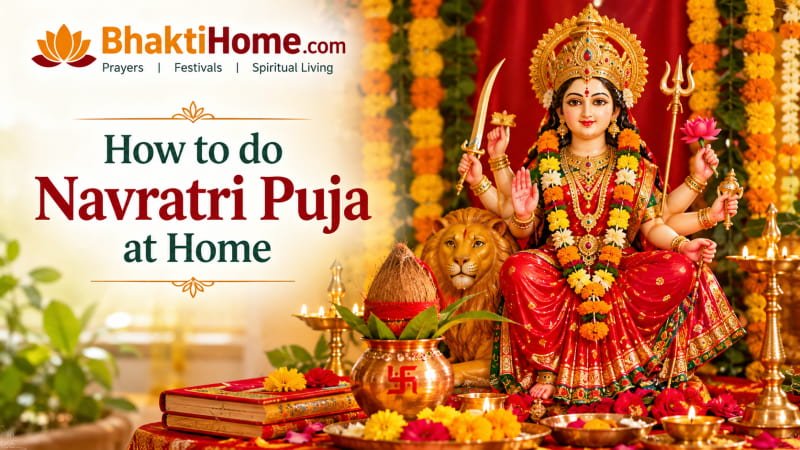
How to do Navratri puja at home - Navratri puja at home is simple to perform if you follow a clear order: clean the space, install the Kalash on Day 1, worship Goddess Durga twice daily with a lamp, flowers, offerings and mantras, honour a different form of the Goddess each day, and conclude with Kanya Pujan and Visarjan.
How to Do Navratri Puja at Home: Complete Vidhi, Samagri and Mantras
You do not need a priest for daily worship, only devotion, cleanliness and consistency.
This guide explains the full nine-day process, with mantras in Hindi, English transliteration and meaning.
1. What is Navratri and Why Do We Worship at Home?
Navratri means "nine nights." During these days, devotees worship the nine forms of Goddess Durga (Navadurga). There are two major Navratris each year: Chaitra Navratri in spring and Sharad Navratri in autumn, the most widely celebrated. Two shorter Gupt Navratris also occur.
Home worship is deeply rooted in tradition. The home becomes a temple for nine days, the family prays together, and the daily routine of cleanliness, fasting and mantra chanting brings discipline and a peaceful atmosphere.
2. Navratri Puja Samagri List (Items Required)
For the Kalash and altar
- Wide clay pot and clean soil
- Barley or Sapta Dhanya (seven grains)
- Brass or clay Kalash with a lid
- Ganga Jal or clean water
- Moli/Kalava (sacred red thread)
- Unpeeled coconut and red chunri
- 5 mango or Ashoka leaves
- Supari (betel nut), coins, durva grass, akshat (unbroken rice)
- Picture or idol of Goddess Durga
- Red cloth for the altar
For daily puja
- Diya, ghee or sesame oil, cotton wicks
- Incense (agarbatti or dhoop) and camphor
- Red hibiscus or marigold flowers and garland
- Roli, kumkum, sandalwood paste (chandan) and turmeric
- Sindoor and bangles, a red dupatta or chunri for the Goddess
- Fruits, sweets or kheer for Naivedya
- Panchamrit (milk, curd, ghee, honey, sugar) for abhishek if you have an idol
- A small bell, water vessel (achamani) and spoon
For Ashtami/Navami
- Havan kund, mango wood, ghee, havan samagri
- Puri, halwa and black chana for Kanya Pujan
- Small gifts or dakshina for the girls
3. Preparing Your Home Puja Space
- Clean the entire house, especially the puja area, before Navratri begins.
- Choose the North-East corner of the home if possible.
- Spread a clean red or yellow cloth on a raised platform (chowki).
- Place the Goddess's idol or picture facing East or West so that you face East or North while worshipping.
- Keep the area free of footwear and clutter.
- Bathe before every puja and wear clean clothes. Red, yellow or other bright colours are traditional.
4. Day 1: Ghatasthapana (Kalash Sthapana)
Navratri begins with Ghatasthapana, the installation of the Kalash, which represents Goddess Durga. It must be done during the proper muhurat, in the first third of the day while Pratipada is prevailing, or in Abhijit Muhurat. Never perform it at night or on Amavasya.
Read our complete guide on how to do Navratri Kalash Sthapana for the full step-by-step process and mantras. In brief:
- Sow barley in layers of soil in the clay pot.
- Fill the Kalash with water, tie Moli on its neck, and add supari, coins, durva, akshat and scent.
- Place five mango leaves around the rim, cover with the lid, and top with the coconut wrapped in the red cloth.
- Install the Kalash on the grain pot, then invoke the Goddess.
5. Daily Navratri Puja Vidhi (Morning and Evening)
Follow this sequence every day. Morning puja takes around 30 to 45 minutes, and the evening puja is shorter, with the lamp and aarti.
Step 1: Bathe and sit in the puja space. Sit on a clean mat (asana) facing East or North.
Step 2: Achaman and self-purification. Sip water three times while chanting the Achamana mantras, then sprinkle water on yourself with the Pavitrikaran mantra.
Step 3: Light the lamp. Light a ghee diya near the Goddess with the Deep mantra.
Step 4: Invoke Ganesha. Always begin with Lord Ganesha to remove obstacles.
Step 5: Take the Sankalp. On Day 1 take the full resolve. On later days a short resolve is enough.
Step 6: Worship the Kalash and Goddess. Offer roli, kumkum, akshat, flowers, a chunri, incense and the lamp.
Step 7: Chant the day's mantra. Chant the Dhyana mantra for that day's form of Durga, then the Navarna mantra (108 times if you can).
Step 8: Read the scripture. Recite the Durga Chalisa, Durga Saptashati or Devi Kavach as your time allows.
Step 9: Offer Naivedya. Offer the day's special bhog, then perform aarti with a camphor flame.
Step 10: Pray for forgiveness and distribute prasad. Share the prasad with the family and water the grain pot.
6. Essential Navratri Puja Mantras (Hindi, Transliteration, Meaning)
Achamana Mantra
हिन्दी:
ॐ केशवाय नमः। ॐ नारायणाय नमः। ॐ माधवाय नमः।
Transliteration:
Om Keshavāya namaḥ | Om Nārāyaṇāya namaḥ | Om Mādhavāya namaḥ |
Meaning: I bow to Keshava, Narayana and Madhava. Sip a little water with each name to purify the body and mind before worship.
Pavitrikaran Mantra
हिन्दी:
ॐ अपवित्रः पवित्रो वा सर्वावस्थां गतोऽपि वा।
यः स्मरेत् पुण्डरीकाक्षं स बाह्याभ्यन्तरः शुचिः॥
Transliteration:
Om apavitraḥ pavitro vā sarvāvasthāṁ gato'pi vā |
yaḥ smaret puṇḍarīkākṣaṁ sa bāhyābhyantaraḥ śuciḥ ||
Meaning: Whether impure or pure, in whatever state one may be, one who remembers the lotus-eyed Lord becomes pure within and without.
Deep (Lamp) Mantra
हिन्दी:
शुभं करोति कल्याणमारोग्यं धनसम्पदा।
शत्रुबुद्धिविनाशाय दीपज्योतिर्नमोऽस्तु ते॥
Transliteration:
Śubhaṁ karoti kalyāṇam ārogyaṁ dhana-sampadā |
śatru-buddhi-vināśāya dīpa-jyotir namo'stu te ||
Meaning: I bow to the light of the lamp, which brings auspiciousness, well-being, health and prosperity, and destroys harmful thoughts.
Ganesh Mantra
हिन्दी:
वक्रतुण्ड महाकाय सूर्यकोटि समप्रभ।
निर्विघ्नं कुरु मे देव सर्वकार्येषु सर्वदा॥
Transliteration:
Vakratuṇḍa mahākāya sūryakoṭi samaprabha |
nirvighnaṁ kuru me deva sarvakāryeṣu sarvadā ||
Meaning: O Lord Ganesha of the curved trunk and mighty form, with the radiance of a million suns, please make all my undertakings free of obstacles.
Durga Avahan Mantra
हिन्दी:
ॐ भूर्भुवः स्वः श्री दुर्गादेवि इहागच्छ, इह तिष्ठ।
श्री दुर्गादेव्यै नमः, आवाहयामि स्थापयामि॥
Transliteration:
Om bhūr bhuvaḥ svaḥ Śrī Durgā-Devi ihāgaccha, iha tiṣṭha |
Śrī Durgāyai namaḥ, āvāhayāmi sthāpayāmi ||
Meaning: O revered Goddess Durga, please come and be seated here. I bow to You, I invoke You and I establish You.
Durga Gayatri Mantra
हिन्दी:
ॐ गिरिजायै च विद्महे शिवप्रियायै च धीमहि।
तन्नो दुर्गा प्रचोदयात्॥
Transliteration:
Om Girijāyai ca vidmahe Śivapriyāyai ca dhīmahi |
tanno Durgā pracodayāt ||
Meaning: We meditate on Girija, the daughter of the mountain, and on the beloved of Shiva. May Goddess Durga illuminate our minds.
Navarna Mantra (Daily Japa)
हिन्दी:
ॐ ऐं ह्रीं क्लीं चामुण्डायै विच्चे॥
Transliteration:
Om aiṁ hrīṁ klīṁ Cāmuṇḍāyai vicce ||
Meaning: This nine-syllable mantra invokes the Goddess as wisdom (Aim), prosperity (Hrim) and power (Klim). Chant 108 times daily on a rudraksha or crystal mala.
Devi Stuti
हिन्दी:
या देवी सर्वभूतेषु शक्तिरूपेण संस्थिता।
नमस्तस्यै नमस्तस्यै नमस्तस्यै नमो नमः॥
Transliteration:
Yā Devī sarvabhūteṣu śakti-rūpeṇa saṁsthitā |
namastasyai namastasyai namastasyai namo namaḥ ||
Meaning: To the Goddess who dwells in all beings as Shakti (power), I bow again and again.
Durga Kshema Mantra (Protection)
हिन्दी:
सर्वस्वरूपे सर्वेशे सर्वशक्तिसमन्विते।
भयेभ्यस्त्राहि नो देवि दुर्गे देवि नमोऽस्तु ते॥
Transliteration:
Sarva-svarūpe sarveśe sarva-śakti-samanvite |
bhayebhyas trāhi no Devi Durge Devi namo'stu te ||
Meaning: O Goddess Durga, You are the form of everything, the Queen of all, endowed with all powers. Protect us from every fear. I bow to You.
Sharanagata Mantra
हिन्दी:
शरणागतदीनार्तपरित्राणपरायणे।
सर्वस्यार्तिहरे देवि नारायणि नमोऽस्तु ते॥
Transliteration:
Śaraṇāgata-dīnārta-paritrāṇa-parāyaṇe |
sarvasyārti-hare Devi Nārāyaṇi namo'stu te ||
Meaning: O Narayani, You are devoted to protecting the helpless and the distressed who seek refuge in You and You remove the suffering of all. I bow to You.
Sarva Mangala Mantra
हिन्दी:
सर्वमङ्गलमाङ्गल्ये शिवे सर्वार्थसाधिके।
शरण्ये त्र्यम्बके गौरि नारायणि नमोऽस्तु ते॥
Transliteration:
Sarva-maṅgala-māṅgalye Śive sarvārtha-sādhike |
śaraṇye tryambake Gauri Nārāyaṇi namo'stu te ||
Meaning: O auspicious one, source of all that is good, who fulfils every purpose, refuge of all, three-eyed Gauri, I bow to You.
Kshama Prarthana (Forgiveness Prayer)
हिन्दी:
आवाहनं न जानामि न जानामि विसर्जनम्।
पूजां चैव न जानामि क्षमस्व परमेश्वरि॥
Transliteration:
Āvāhanaṁ na jānāmi na jānāmi visarjanam |
pūjāṁ caiva na jānāmi kṣamasva Parameśvari ||
Meaning: I do not know how to invoke You, how to bid You farewell, or how to worship You. O Supreme Goddess, please forgive me.
7. Nine Forms of Durga: Day-Wise Puja Guide
Each day is dedicated to one form of the Goddess, with a traditional offering (bhog). Chant her mantra 11, 21 or 108 times during puja. Note that the colour for each day depends on the weekday it falls on, so check a Panchang or Navratri calendar for the current year's colours.
Day 1: Maa Shailputri
Bhog: Pure ghee
हिन्दी:
वन्दे वाञ्छितलाभाय चन्द्रार्धकृतशेखराम्।
वृषारूढां शूलधरां शैलपुत्रीं यशस्विनीम्॥
Transliteration:
Vande vāñchita-lābhāya candrārdha-kṛta-śekharām |
vṛṣārūḍhāṁ śūladharāṁ Śailaputrīṁ yaśasvinīm ||
Meaning: I bow to the glorious Shailputri, who wears the half-moon on her crown, rides the bull and holds the trident, for the fulfilment of my wishes.
Day 2: Maa Brahmacharini
Bhog: Sugar or sweets made with sugar
हिन्दी:
दधाना करपद्माभ्यामक्षमालाकमण्डलू।
देवी प्रसीदतु मयि ब्रह्मचारिण्यनुत्तमा॥
Transliteration:
Dadhānā kara-padmābhyām akṣamālā-kamaṇḍalū |
Devī prasīdatu mayi Brahmacāriṇy anuttamā ||
Meaning: May the supreme Goddess Brahmacharini, who holds a rosary and a water pot in her lotus-like hands, be gracious to me.
Day 3: Maa Chandraghanta
Bhog: Milk and kheer
हिन्दी:
पिण्डजप्रवरारूढा चण्डकोपास्त्रकैर्युता।
प्रसादं तनुते मह्यं चन्द्रघण्टेति विश्रुता॥
Transliteration:
Piṇḍaja-pravarārūḍhā caṇḍakopāstrakair yutā |
prasādaṁ tanute mahyaṁ Candraghaṇṭeti viśrutā ||
Meaning: May Goddess Chandraghanta, who rides a mighty lion and wields fierce weapons, bestow her grace upon me.
Day 4: Maa Kushmanda
Bhog: Malpua
हिन्दी:
सुरासम्पूर्णकलशं रुधिराप्लुतमेव च।
दधाना हस्तपद्माभ्यां कूष्माण्डा शुभदास्तु मे॥
Transliteration:
Surā-sampūrṇa-kalaśaṁ rudhirāplutam eva ca |
dadhānā hasta-padmābhyāṁ Kūṣmāṇḍā śubhadāstu me ||
Meaning: May Goddess Kushmanda, who holds a pot of nectar in her lotus hands, grant me auspiciousness.
Day 5: Maa Skandamata
Bhog: Bananas
हिन्दी:
सिंहासनगता नित्यं पद्माश्रितकरद्वया।
शुभदास्तु सदा देवी स्कन्दमाता यशस्विनी॥
Transliteration:
Siṁhāsana-gatā nityaṁ padmāśrita-karadvayā |
śubhadāstu sadā Devī Skandamātā yaśasvinī ||
Meaning: May the glorious Skandamata, mother of Kartikeya, seated on a lion throne with lotuses in her hands, always bestow auspiciousness.
Day 6: Maa Katyayani
Bhog: Honey
हिन्दी:
चन्द्रहासोज्ज्वलकरा शार्दूलवरवाहना।
कात्यायनी शुभं दद्याद्देवी दानवघातिनी॥
Transliteration:
Candrahāsojjvala-karā śārdūla-vara-vāhanā |
Kātyāyanī śubhaṁ dadyād Devī dānava-ghātinī ||
Meaning: May Goddess Katyayani, with a gleaming sword in her hand, riding a magnificent lion and destroyer of demons, grant auspiciousness.
Day 7: Maa Kalaratri
Bhog: Jaggery (gud)
हिन्दी:
ॐ देवी कालरात्र्यै नमः॥
Transliteration:
Om Devī Kālarātryai namaḥ ||
Meaning: Salutations to Goddess Kalaratri, the fierce form who destroys darkness, ignorance and fear.
Day 8: Maa Mahagauri
Bhog: Coconut
हिन्दी:
श्वेते वृषे समारूढा श्वेताम्बरधरा शुचिः।
महागौरी शुभं दद्यान्महादेवप्रमोददा॥
Transliteration:
Śvete vṛṣe samārūḍhā śvetāmbara-dharā śuciḥ |
Mahāgaurī śubhaṁ dadyān Mahādeva-pramoda-dā ||
Meaning: May the pure Mahagauri, seated on a white bull, dressed in white and dear to Lord Shiva, bestow auspiciousness.
Day 9: Maa Siddhidatri
Bhog: Sesame seeds (til)
हिन्दी:
सिद्धगन्धर्वयक्षाद्यैरसुरैरमरैरपि।
सेव्यमाना सदा भूयात् सिद्धिदा सिद्धिदायिनी॥
Transliteration:
Siddha-gandharva-yakṣādyair asurair amarair api |
sevyamānā sadā bhūyāt siddhidā siddhidāyinī ||
Meaning: May Siddhidatri, worshipped always by Siddhas, Gandharvas, Yakshas, demons and gods, grant perfection and spiritual powers.
8. Navratri Fasting Rules (Vrat Niyam)
Fasting is optional but widely observed. Choose a form that suits your health.
- Foods generally allowed: Fruits, milk, curd, sabudana, kuttu (buckwheat) or singhara flour, samak rice, potatoes, sweet potatoes, nuts and rock salt (sendha namak).
- Foods avoided: Onion, garlic, grains such as wheat and rice, regular salt, meat, eggs and alcohol.
- Other niyams: Avoid shaving and cutting hair or nails, sleep on the floor or a simple bed if you can, avoid anger and arguments, and observe brahmacharya.
- Health first: Children, elderly people, pregnant women and anyone with medical conditions should fast only as advised by their doctor. Devotion matters more than the strictness of the fast.
9. Durga Saptashati and Akhand Jyoti
Durga Saptashati (Devi Mahatmya) is the main scripture of Navratri, with 700 verses in 13 chapters. Many families recite it across the nine days, preceded by Devi Kavach, Argala Stotra and Keelak Stotra. If this is too long, reciting the Durga Chalisa or Sidhkunjika Stotra daily is a respected alternative.
Akhand Jyoti is a lamp kept burning day and night beside the Kalash. Use ghee or sesame oil, protect it from wind, and make sure someone can tend it. If you cannot keep it lit continuously, light a diya at sunrise and sunset instead.
10. Ashtami and Navami: Havan and Kanya Pujan
Havan
Many families perform a small Havan on Ashtami or Navami.
- Light the havan kund with mango wood and camphor.
- Offer ghee and havan samagri with the mantra below, ending each chant with Svaha.
हिन्दी:
ॐ ऐं ह्रीं क्लीं चामुण्डायै विच्चे स्वाहा॥
Transliteration:
Om aiṁ hrīṁ klīṁ Cāmuṇḍāyai vicce svāhā ||
Meaning: An offering of the Navarna mantra into the sacred fire to please the Goddess.
- Offer a final oblation (purnahuti) with a coconut and end with aarti.
Kanya Pujan (Worship of Young Girls)
Kanya Pujan honours the nine forms of the Goddess as nine young girls.
- Invite nine girls (aged about 2 to 10) and one young boy (the "Langur" or Batuk Bhairav).
- Wash their feet, apply tilak and tie Moli on their wrists.
- Offer a meal of puri, halwa and black chana.
- Give gifts, fruits or dakshina and seek their blessings by touching their feet.
A simple salutation while worshipping them:
हिन्दी:
ॐ कुमार्यै नमः॥
Transliteration:
Om Kumāryai namaḥ ||
Meaning: I bow to the Goddess in the form of the young girl.
11. Visarjan and Conclusion
On Dashami (or after the final puja on Navami, per your family tradition):
- Perform the final aarti and recite the Kshama Prarthana.
- Thank the Goddess for residing in your home and gently take the Kalash from its place.
- Distribute the grown barley sprouts as prasad. Keep a few in your puja room and wallet by tradition.
- Pour the Kalash water at the base of a tree or into a river, never somewhere disrespectful.
- Immerse the coconut and the remaining puja material in running water or bury them in clean soil.
12. Navratri Puja Dos and Don'ts
Do:
- Keep the home clean and the puja corner tidy.
- Worship at the same time each day for consistency.
- Water the barley lightly each day.
- Speak kindly and maintain satvik food and thoughts.
- Keep the lamp lit and the Kalash undisturbed.
Don't:
- Perform Ghatasthapana at night or on Amavasya.
- Use cracked or damaged vessels.
- Eat onion, garlic, meat or alcohol during these days.
- Leave the house locked for long periods without a lamp tended.
- Worry about small mistakes. Sincere devotion and forgiveness prayer are enough.
13. Frequently Asked Questions (FAQs)
Q1. How do I do Navratri puja at home without a pandit?
Install the Kalash on Day 1, light a lamp, offer flowers, incense and bhog, chant the Durga mantras given above, and conclude with aarti. A priest is helpful but not required.
Q2. What is the best time for Navratri puja?
Ghatasthapana must be done in the proper muhurat on Pratipada. For daily puja, early morning (Brahma Muhurta to sunrise) and evening at sunset are best.
Q3. Can I perform Navratri puja if I am not fasting?
Yes. Worship and fasting are separate. You can do the puja and eat satvik food even if you do not fast.
Q4. Which mantra should I chant daily during Navratri?
The Navarna mantra (Om Aim Hrim Klim Chamundayai Vichche) and the Durga Gayatri are widely chanted. Reciting the Devi Stuti is also easy for beginners.
Q5. Can women perform Navratri puja during periods?
Traditions vary. Many families avoid touching the Kalash and idol but still pray mentally or listen to mantras. Follow your family custom and consult an elder or priest if unsure.
Q6. What if I make a mistake during the puja?
Chant the Kshama Prarthana at the end. The Goddess values devotion above perfect ritual.
Q7. How many days should the Kalash stay at home?
Until the Visarjan on Navami or Dashami, according to your family tradition.
Q8. Can I travel or go to work during Navratri?
Yes. Complete your morning puja and ensure the lamp is tended, or keep a simple evening puja. Many people carry on their regular work while observing Navratri.
Conclusion
Navratri puja at home is a journey of discipline, devotion and gratitude. Begin with a proper Ghatasthapana, worship the Goddess each morning and evening, honour the nine forms with their mantras, and conclude with Kanya Pujan and Visarjan. May Maa Durga bless your home with peace, health and prosperity. Jai Mata Di! 🙏
Disclaimer: Rituals, mantras and customs differ across regions and family traditions. Please follow the guidance of your family priest or lineage where it differs. Check a local Panchang for exact muhurat timings and dates for your city.