
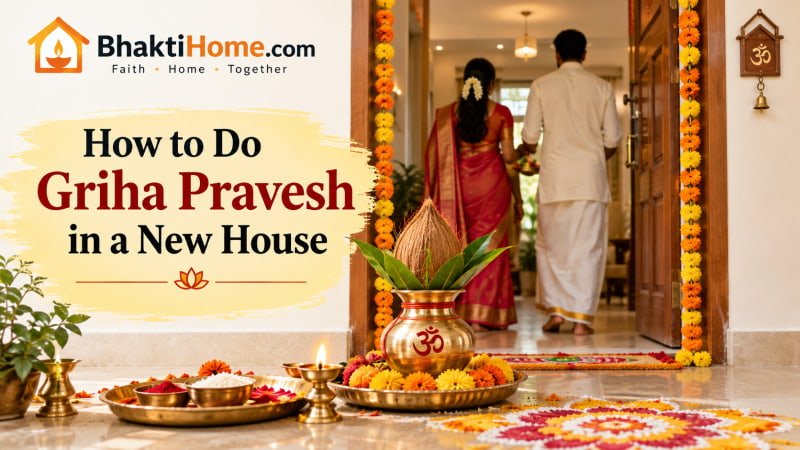
How to do Griha Pravesh in new House - Griha Pravesh is a traditional Hindu housewarming ceremony performed when entering a new home for the first time. It is believed to invite positive energy, peace, prosperity, and Goddess Lakshmi’s blessings into the house. From choosing an auspicious date and performing Ganesh Puja to entering the home with traditional rituals, this guide explains how to do Griha Pravesh in a new house, including the essential puja items, step-by-step procedure, and important customs to follow.
How to Griha Pravesh in new House | How to Perform the Housewarming Ceremony in Your New Home
A complete guide to the rituals, samagri (materials), step-by-step procedure and mantras in Hindi and English
Note: Griha Pravesh customs vary by region, family tradition (sampradaya) and the priest who conducts the ceremony. This guide follows the widely practised North and Central Indian Vedic/Puranic method. Please confirm the muhurat and any local variations with your family pandit or a trusted Panchang.
1. What Is Griha Pravesh?
Griha Pravesh (गृह प्रवेश) literally means entering the home. It is the Hindu ceremony performed before a family begins living in a new house, so that the home is purified, the deities and the Vastu Purusha are honoured, negative influences are removed, and the household begins life with peace, health and prosperity (Lakshmi's blessings).
The house is seen as a living space that should be 'invited' into use through worship, not merely occupied. That is why the ceremony is performed with a proper muhurat, a sacred fire (havan) and the recitation of mantras.
2. Types of Griha Pravesh
- Apoorva Griha Pravesh (अपूर्व): entering a newly built or newly purchased house for the very first time. This is the most elaborate form.
- Sapoorva / Punah Griha Pravesh (सपूर्व): re-entering a house after being away for a long time, for example after living abroad or in another city.
- Dwandwah Griha Pravesh (द्वन्द्व): entering again after the house has been affected by a calamity such as fire, flood, or major reconstruction.
Some traditions also describe Sapoorva as occupying a house that has been lived in before (a rented or second-hand home). The core rituals are similar in all cases; Apoorva has the fullest procedure.
3. Choosing the Auspicious Muhurat
The muhurat is calculated from the Panchang (tithi, vaar, nakshatra, yoga, karana) and the family's horoscopes. General guidelines followed by many pandits:
- Auspicious months: Magha, Phalguna, Vaishakha and Jyeshtha are traditionally considered best. Some traditions also permit Kartika and Margashirsha.
- Period to avoid: Chaturmas (roughly from Devshayani Ekadashi to Prabodhini/Dev Uthani Ekadashi), Pitru Paksha, Adhik Maas (the extra month), and the time when Guru (Jupiter) or Shukra (Venus) is combust/set (asta).
- Auspicious tithis: commonly 2, 3, 5, 7, 10, 11 and 13 of the bright and dark fortnights; Rikta tithis (4, 9, 14), Amavasya and Purnima are usually avoided.
- Good weekdays: Monday, Wednesday, Thursday and Friday. Tuesday, Saturday and Sunday are generally avoided for Apoorva Griha Pravesh.
- Favourable nakshatras: Rohini, Mrigashira, Uttara Phalguni, Uttara Ashadha, Uttara Bhadrapada, Anuradha, Revati, Chitra, Dhanishtha, Shatabhisha and Pushya are commonly listed.
- Time of day: early morning (Brahma muhurat to sunrise-time) or a stable lagna (Sthir lagna) is preferred.
- Uttarayana (sun's northward movement) is considered more favourable, though the other criteria matter more in practice.
Because these rules depend on exact dates and your personal charts, do get the muhurat prepared by a qualified pandit. I can also help you look up current muhurat dates if you tell me your preferred window.
4. Before the Day: Preparations
- Complete the essentials first. The main door, roof, windows, flooring, kitchen, and at least basic water and electricity should be in place. The house should not be incomplete or have major construction ongoing.
- Deep clean the house. Sweep and mop every room. Many families sprinkle Gangajal mixed with water in each corner.
- Declutter and remove construction debris. Keep no broken or unused items inside.
- Book the pandit and confirm the ceremony timing, samagri list and the number of people attending.
- Invite family, friends and neighbours. Plan the bhojan (meal) for guests and Brahmins.
- Decorate the entrance: a toran of fresh mango and ashoka leaves with marigold flowers over the main door, a swastika drawn with kumkum or turmeric on both sides of the door, and a rangoli at the threshold.
- Keep the house open and lit. On the evening before, many families leave a lamp (diya) lit and place a jar of water at the entrance.
- Fast or eat light on the day, as is customary for those performing the puja.
5. Samagri: Puja Materials Checklist
For the entrance and kalash
- Brass or copper kalash (pot), coconut with its tuft, mango leaves (5 or 7), red or yellow cloth, kalawa/mauli (sacred thread)
- Gangajal, clean water, rice grains (akshat), betel nut, coins
- Rangoli colours, kumkum, turmeric (haldi), sandalwood paste (chandan)
For worship
- Idols or pictures of Ganesha, Lakshmi, Vishnu/Satyanarayan and your Ishta Devata and Kuldevata
- Flowers, garlands, durva grass, tulsi leaves, bel patra (as per deity)
- Incense sticks (agarbatti), dhoop, ghee diya, camphor (kapur)
- Naivedya: fruits, sweets, panchamrit (milk, curd, ghee, honey, sugar)
- Betel leaves (paan), supari, cloves, cardamom
For the havan
- Havan kund (or a copper/brass vessel), mango wood samidha, cow dung cakes (if used), camphor
- Havan samagri, pure ghee, black sesame, barley, rice, sugar, a small ladle (sruva)
- Navagraha items: nine types of grain, nine cloth pieces (as your pandit advises)
For the kitchen
- New vessel, milk, rice and jaggery or sugar for the first boiling of milk
- A matchbox or lighter to light the stove with a lit lamp as a symbolic first act
Others
- A new broom is traditionally kept ready; nameplate; Vastu yantra if recommended; dakshina for the pandit; clothes or gifts to give
6. Step-by-Step Griha Pravesh Procedure
Step 1: Purification and Ganesha worship (Ganesh Pujan)
The family bathes and wears clean, preferably traditional clothes. The puja always begins with Lord Ganesha, the remover of obstacles. Sit facing east or north, light the lamp, perform achamana (sipping water thrice) and apply tilak.
Step 2: Sankalp (the vow)
The head of the family takes water, rice and flowers in the right hand and states the resolve: name, gotra, date, place and the purpose, which is to enter and live in the new home. The priest guides the exact Sanskrit wording. A simple version in Hindi is given in the mantra section below.
Step 3: Kalash Sthapana
Fill the kalash with clean water and a little Gangajal. Place mango leaves on the rim, set a coconut wrapped with a red cloth on top, and tie kalawa around the neck. Place it in the north-east of the main puja area on a bed of rice. This represents all deities and sacred rivers.
Step 4: Vastu Purusha and Navagraha puja
The Vastu Purusha (the presiding spirit of the land and dwelling) and the nine planets are worshipped to remove Vastu dosha and planetary obstacles. Offerings of flowers, rice, and the beej mantras of each graha are made.
Step 5: The actual entry (Griha Pravesh)
At the muhurat time:
- The kalash is carried in by the lady of the house (or the couple together), who is the symbolic bringer of Lakshmi.
- The family stands at the threshold. Some families have the pandit chant the entry mantra while the door is opened.
- Enter with the right foot first. The head of the family and his wife usually enter together, carrying the kalash, a lit lamp, a picture or idol of the family deity and often the Ramayana, Gita or another sacred text.
- Many families make Lakshmi's footprints (charan) with rice flour or alta paste. Others have the woman of the house gently tip a vessel of rice at the door so that it spills inward.
- Do not step on the threshold itself. Step over it.
- Ring a bell or blow a conch (shankh) during the entry.
The family should enter before anyone else, and the house should not be left empty or locked after this point for the first night. Ideally someone stays in the house that night.
Step 6: Boiling milk (Doodh Ubalna)
Go to the kitchen and light the stove with a lamp or lit camphor. Boil milk in a new vessel until it overflows. The overflowing milk symbolises abundance, prosperity and that the home will never lack for food. Prepare kheer or a sweet dish from this milk and offer it to the deities first.
Step 7: Havan (Homa)
Light the sacred fire and make offerings of ghee and samagri with 'Svaha' for Agni, Ganesha, Vastu Purusha, the Navagrahas, and Lakshmi-Vishnu. Chant the Gayatri mantra 108 times if possible. Complete with Purnahuti.
Step 8: Aarti, Prasad and Dakshina
Perform the aarti for the deities, distribute prasad, and offer dakshina to the pandit. Touch the feet of elders and the priest for blessings.
Step 9: Bhojan and Daan
Host a meal for Brahmins, relatives and neighbours. Donating food, clothes, or money to the needy is a strongly recommended part of the occasion.
Step 10 (optional): Satyanarayan Katha
Many families perform Satyanarayan Katha in the new house on the same day or soon after for blessings and peace.
7. Mantras for Griha Pravesh (Hindi, English transliteration and meaning)
The mantras below are those most commonly chanted at Griha Pravesh. Where possible, Vedic mantras should be recited with proper pronunciation, ideally by or under the guidance of a pandit. If you are not able to chant long Sanskrit verses correctly, simple names and beej mantras said with devotion are accepted in the tradition.
7.1 Achamana (sipping water for purity)
Take a little water in the right palm and sip it three times while chanting:
ॐ केशवाय नमः। ॐ नारायणाय नमः। ॐ माधवाय नमः।
Om Keshavaya namah. Om Narayanaya namah. Om Madhavaya namah.
Meaning: Salutations to Keshava, Narayana and Madhava (names of Vishnu).
7.2 Pavitrikaran (self-purification)
Sprinkle water on yourself and the samagri:
ॐ अपवित्रः पवित्रो वा सर्वावस्थां गतोऽपि वा। यः स्मरेत् पुण्डरीकाक्षं स बाह्याभ्यन्तरः शुचिः॥
Om apavitrah pavitro va sarvavastham gato 'pi va; yah smaret pundarikaksham sa bahyabhyantarah shuchih.
Meaning: Whether impure or pure, or in any condition, one who remembers the lotus-eyed Lord becomes pure inside and out.
7.3 Ganesh Vandana (invocation of Lord Ganesha)
वक्रतुण्ड महाकाय सूर्यकोटि समप्रभ। निर्विघ्नं कुरु मे देव सर्वकार्येषु सर्वदा॥
Vakratunda mahakaya suryakoti-samaprabha; nirvighnam kuru me deva sarva-karyeshu sarvada.
Meaning: O Lord with the curved trunk and mighty body, radiant as a million suns, please remove all obstacles from all my undertakings, always.
Beej mantra: ॐ गं गणपतये नमः। (Om Gam Ganapataye namah.) Chant 11 or 21 times.
7.4 Sankalp (simple Hindi form)
Holding water, rice and flowers, the yajamaan says (the priest will add the full Sanskrit sankalp with gotra, date and place):
मैं (नाम), (गोत्र) गोत्र में उत्पन्न, अपने परिवार की सुख, शांति, समृद्धि तथा इस नवीन गृह में निर्विघ्न निवास के लिए गृह प्रवेश पूजन का संकल्प करता/करती हूँ।
Main (name), (gotra) gotra mein utpann, apne parivaar ki sukh, shanti, samriddhi tatha is naveen griha mein nirvighna nivaas ke liye Griha Pravesh pujan ka sankalp karta/karti hoon.
Meaning: I, (name) of (gotra) lineage, resolve to perform the Griha Pravesh worship for the happiness, peace and prosperity of my family and for trouble-free residence in this new home.
7.4A Sanctifying the water (Tirtha avahan)
गङ्गे च यमुने चैव गोदावरि सरस्वति। नर्मदे सिन्धु कावेरि जलेऽस्मिन् सन्निधिं कुरु॥
Gange cha Yamune chaiva Godavari Sarasvati; Narmade Sindhu Kaveri jale 'smin sannidhim kuru.
Meaning: O Ganga, Yamuna, Godavari, Sarasvati, Narmada, Sindhu and Kaveri, please be present in this water.
This water is then sprinkled throughout the house to purify it.
7.5 Swasti Vachan (invoking auspiciousness)
ॐ स्वस्ति न इन्द्रो वृद्धश्रवाः स्वस्ति नः पूषा विश्ववेदाः। स्वस्ति नस्तार्क्ष्यो अरिष्टनेमिः स्वस्ति नो बृहस्पतिर्दधातु॥
Om svasti na Indro vriddhashravah svasti nah Pusha vishvavedah; svasti nas tarkshyo arishtanemih svasti no Brihaspatir dadhatu.
Meaning: May Indra of ancient glory grant us well-being; may Pusha, the all-knowing, grant us well-being; may Tarkshya, the protector from harm, grant us well-being; may Brihaspati grant us well-being. (Rigveda)
7.6 Kalash Sthapana mantra
ॐ कलशस्य मुखे विष्णुः कण्ठे रुद्रः समाश्रितः। मूले तत्र स्थितो ब्रह्मा मध्ये मातृगणाः स्मृताः॥ कुक्षौ तु सागराः सर्वे सप्तद्वीपा वसुन्धरा। ऋग्वेदोऽथ यजुर्वेदः सामवेदो ह्यथर्वणः। अङ्गैश्च सहिताः सर्वे कलशं तु समाश्रिताः॥
Om kalashasya mukhe Vishnuh kanthe Rudrah samashritah; mule tatra sthito Brahma madhye matri-ganah smritah. Kukshau tu sagarah sarve sapta-dvipa vasundhara; Rigvedo 'tha Yajurvedah Samavedo hy Atharvanah; angaish cha sahitah sarve kalasham tu samashritah.
Meaning: In the mouth of the kalash resides Vishnu, in its neck Rudra, at its base Brahma, and in its middle the Divine Mothers. In its belly are all the oceans, the seven continents and the Earth. The four Vedas with all their limbs are present in this kalash.
7.7 Vastu Purusha / Vastoshpati mantra
ॐ वास्तोष्पते प्रति जानीह्यस्मान् स्वावेशो अनमीवो भवा नः। यत्त्वेमहे प्रति तन्नो जुषस्व शं नो भव द्विपदे शं चतुष्पदे॥
Om Vastoshpate prati janihy asman svaveshо anamivo bhava nah; yat tvemahe prati tan no jushasva sham no bhava dvipade sham chatushpade.
Meaning: O Lord of the dwelling, accept us, be a gracious and disease-free abode for us. Grant what we ask of you, and bring well-being to our two-footed (people) and four-footed (animals). (Rigveda 7.54.1)
Short form: ॐ वास्तोष्पतये नमः। (Om Vastoshpataye namah.)
7.8 Navagraha beej mantras
Chant each at least 11 times, or as your pandit advises:
| Graha | Mantra (Hindi) | Transliteration |
|---|---|---|
| Surya (Sun) | ॐ ह्रां ह्रीं ह्रौं सः सूर्याय नमः | Om Hram Hrim Hraum Sah Suryaya namah |
| Chandra (Moon) | ॐ श्रां श्रीं श्रौं सः चन्द्रमसे नमः | Om Shram Shrim Shraum Sah Chandramase namah |
| Mangal (Mars) | ॐ क्रां क्रीं क्रौं सः भौमाय नमः | Om Kram Krim Kraum Sah Bhaumaya namah |
| Budh (Mercury) | ॐ ब्रां ब्रीं ब्रौं सः बुधाय नमः | Om Bram Brim Braum Sah Budhaya namah |
| Guru (Jupiter) | ॐ ग्रां ग्रीं ग्रौं सः गुरवे नमः | Om Gram Grim Graum Sah Gurave namah |
| Shukra (Venus) | ॐ द्रां द्रीं द्रौं सः शुक्राय नमः | Om Dram Drim Draum Sah Shukraya namah |
| Shani (Saturn) | ॐ प्रां प्रीं प्रौं सः शनैश्चराय नमः | Om Pram Prim Praum Sah Shanaishcharaya namah |
| Rahu | ॐ भ्रां भ्रीं भ्रौं सः राहवे नमः | Om Bhram Bhrim Bhraum Sah Rahave namah |
| Ketu | ॐ स्रां स्रीं स्रौं सः केतवे नमः | Om Sram Srim Sraum Sah Ketave namah |
7.9 Entry mantras (while stepping into the house)
These verses come from the Vedic Grihya tradition (for example, the Paraskara Grihya Sutra and Atharvaveda) and are often recited by the pandit as the family crosses the threshold. Wording can vary slightly between Shakhas (Vedic branches).
ॐ गृहानहं सुमनसः प्रपद्ये अवीरहा वीरवतः सुवीरान्। इरां वहतो घृतमुक्षमाणास्तेष्वहं सुमनाः संविशामि॥
Om grihan aham sumanasah prapadye aviraha viravatah suviran; iram vahato ghritam ukshamanas teshv aham sumanah samvishami.
Meaning: With a cheerful mind I enter this home, which is free from harm to heroes and filled with brave and good people, which bears nourishment and is sprinkled with ghee. In it I dwell with a glad heart.
ॐ गृहा मा बिभीत मा वेपध्वम् ऊर्जं बिभ्रत एमसि। ऊर्जं बिभ्रद्वः सुमनाः सुमेधा गृहान् ऐमि मनसा मोदमानः॥
Om griha ma bibhita ma vepadhvam urjam bibhrata emasi; urjam bibhrad vah sumanah sumedha grihan aimi manasa modamanah.
Meaning: O house, do not fear, do not tremble. We come to you bringing strength and vitality. With a happy mind and good wisdom, I enter your premises rejoicing.
A simple alternative if the above are difficult: chant ॐ श्री गणेशाय नमः and ॐ श्रीं महालक्ष्म्यै नमः (Om Shri Ganeshaya namah; Om Shrim Mahalakshmyai namah) as you cross the threshold.
7.10 Lakshmi mantra (for prosperity in the new home)
ॐ श्रीं ह्रीं श्रीं कमले कमलालये प्रसीद प्रसीद। श्रीं ह्रीं श्रीं ॐ महालक्ष्म्यै नमः॥
Om Shrim Hrim Shrim Kamale Kamalalaye prasida prasida; Shrim Hrim Shrim Om Mahalakshmyai namah.
Meaning: O Lotus-seated Goddess who dwells in the lotus, please be gracious, be gracious. Salutations to Mahalakshmi.
Chant at the kitchen milk-boiling and at the main puja.
7.11 Gayatri mantra (for the havan)
ॐ भूर्भुवः स्वः। तत्सवितुर्वरेण्यं भर्गो देवस्य धीमहि। धियो यो नः प्रचोदयात्॥
Om bhur bhuvah svah; tat savitur varenyam bhargo devasya dhimahi; dhiyo yo nah prachodayat.
Meaning: We meditate on the radiant glory of the divine Sun (Savitr) who illumines the earth, the atmosphere and the heavens; may he inspire our intellect.
7.12 Havan ahuti mantras (offer ghee with each 'Svaha')
At the end of each line, offer a spoonful of ghee/samagri into the fire.
- ॐ अग्नये स्वाहा। इदमग्नये न मम। (Om Agnaye svaha; idam Agnaye na mama.)
- ॐ गणेशाय स्वाहा। (Om Ganeshaya svaha.)
- ॐ वास्तोष्पतये स्वाहा। (Om Vastoshpataye svaha.)
- ॐ प्रजापतये स्वाहा। इदं प्रजापतये न मम। (Om Prajapataye svaha; idam Prajapataye na mama.)
- ॐ इन्द्राय स्वाहा। इदमिन्द्राय न मम। (Om Indraya svaha; idam Indraya na mama.)
- ॐ सोमाय स्वाहा। इदं सोमाय न मम। (Om Somaya svaha; idam Somaya na mama.)
- ॐ श्रीं महालक्ष्म्यै स्वाहा। (Om Shrim Mahalakshmyai svaha.)
- ॐ नवग्रहेभ्यः स्वाहा। (Om Navagrahebhyah svaha.)
The phrase 'idam ... na mama' means: this offering is for that deity and not for me.
7.13 Mahamrityunjaya mantra (health and protection of the family)
ॐ त्र्यम्बकं यजामहे सुगन्धिं पुष्टिवर्धनम्। उर्वारुकमिव बन्धनान्मृत्योर्मुक्षीय माऽमृतात्॥
Om Tryambakam yajamahe sugandhim pushti-vardhanam; urvarukam iva bandhanan mrityor mukshiya mamritat.
Meaning: We worship the three-eyed Lord, fragrant and the nourisher of all. As a ripe cucumber is freed from its stem, may we be freed from death, not from immortality.
7.14 Purnahuti and Shanti Path (closing)
ॐ पूर्णमदः पूर्णमिदं पूर्णात् पूर्णमुदच्यते। पूर्णस्य पूर्णमादाय पूर्णमेवावशिष्यते॥
Om purnam adah purnam idam purnat purnam udachyate; purnasya purnam adaya purnam evavashishyate.
Meaning: That is whole, this is whole; from the whole the whole arises; taking the whole from the whole, the whole remains.
ॐ द्यौः शान्तिरन्तरिक्षं शान्तिः पृथिवी शान्तिरापः शान्तिरोषधयः शान्तिः। वनस्पतयः शान्तिर्विश्वेदेवाः शान्तिर्ब्रह्म शान्तिः सर्वं शान्तिः शान्तिरेव शान्तिः सा मा शान्तिरेधि॥ ॐ शान्तिः शान्तिः शान्तिः॥
Om dyauh shantir antariksham shantih prithivi shantir apah shantir oshadhayah shantih; vanaspatayah shantir vishvedevah shantir Brahma shantih sarvam shantih shantir eva shantih sa ma shantir edhi. Om shantih shantih shantih.
Meaning: May there be peace in the heavens, in the sky, on the earth, in the waters, in the herbs, in the trees, among all the gods, in Brahman, in all things, and may that peace come to me. Om, peace, peace, peace.
8. Vastu Tips for the New Home
- Main entrance: keep it clean, well lit and uncluttered. Doors should open inward without creaking. Avoid placing a dustbin or shoe rack right at the entrance.
- Puja room: ideally in the north-east (Ishan) corner, with the idols facing east or west.
- Kitchen: traditionally in the south-east (Agneya) corner; the cook ideally faces east while cooking.
- Master bedroom: south-west. Keep the head towards south or east while sleeping.
- Water: keep the north-east free of heavy items and toilets.
- Light and ventilation: let natural light and fresh air flow through the house on the first day.
- Nameplate and Om/Swastika: install on the main door.
These are traditional Vastu recommendations; follow what is practical for your layout, and consult a Vastu expert if you have specific concerns.
9. Do's and Don'ts
Do
- Complete the puja at the exact muhurat.
- Enter with the right foot and with a joyful, calm mind.
- Keep the lamp lit in the puja space through the first night.
- Sleep in the house on the first night, ideally with family.
- Offer food to the deities before eating.
- Donate food, clothes or money to those in need.
Don't
- Don't enter an unfinished or dirty house.
- Don't enter in the dark or at an inauspicious time such as Rahu Kaal.
- Don't carry empty vessels in; carry the kalash filled with water or grain.
- Don't quarrel or use harsh words in the house on the first day.
- Don't leave the house locked or empty on the first night.
10. Frequently Asked Questions
Can Griha Pravesh be done without a pandit? Yes. If a pandit is not available, the family can perform a simple puja: Ganesha worship, kalash sthapana, entering with the kalash, boiling milk, and chanting Gayatri, Mahamrityunjaya and Lakshmi mantras with sincerity. A pandit is recommended for the full Vedic havan and Vastu puja.
Can we do Griha Pravesh in a rented house? Yes. A simple puja with Ganesha, Vastu and Lakshmi worship and boiling milk is commonly done when moving into a rented home.
Do we need to move all the furniture in first? Not necessarily. Many families do the ceremony first and shift furniture afterwards. At least a bed, the kitchen essentials and the puja items should be in place.
What if the best muhurat falls on a day I cannot attend? A family member can perform the entry at the muhurat, and the rest of the family can follow later. Discuss options with your pandit.
How long does the ceremony take? A simple puja takes about 1 to 2 hours. A full ceremony with havan, Vastu and Navagraha puja can take 3 to 4 hours or more.
11. Summary Checklist
- Fix the muhurat with a pandit using the Panchang.
- Complete and clean the house; decorate the entrance.
- Arrange samagri, kalash, havan items and food.
- Begin with Ganesh puja and sankalp.
- Install the kalash; perform Vastu and Navagraha puja.
- Enter at the muhurat with the right foot, carrying the kalash and lamp.
- Boil milk in the kitchen.
- Perform the havan with Gayatri and ahuti mantras; offer Purnahuti.
- Do the aarti, distribute prasad, and give dakshina and daan.
- Feed guests, take blessings, and stay in the house that night.
May your new home be filled with peace, health, prosperity and joy.
ॐ शान्तिः शान्तिः शान्तिः॥